Flap Barrier vs Swing Barrier vs Speed Gate: How to Choose
October 29, 2026
A flap barrier, a swing barrier and a speed gate all do the same job. Each holds a lane shut until the access control system accepts a credential, then lets one person through. The choice between them comes down to five things: how wide the lane must be, how high the barrier needs to stand, how much lobby width there is, whether the gate stands indoors or out, and what it must do when the fire alarm sounds.
Throughput is usually the first figure buyers compare, and it is the one that separates them least. Across the Vantage range, most flap barriers, swing barriers and speed gates are rated at 35 to 40 people a minute. This guide works through the differences that do matter, with lane widths, cabinet sizes and ratings for 27 Vantage models.
It covers half height lanes and glass speed gates. Tripod and full height turnstiles, which suit perimeters and unattended sites, are covered in the turnstile gate buyer's guide.
What is the difference between a flap barrier, a swing barrier & a speed gate?
The difference is how the barrier moves and how tall it stands. A flap barrier retracts two short flaps into its cabinets, a swing barrier swings its doors open in the direction of travel, and a speed gate uses glass panels that slide into the machine core.
Flap barrier
Two acrylic or polycarbonate flaps meet in the middle of the lane and fold back into the cabinets when a valid credential is read. The standard Vantage flap lane is 550 mm, the narrowest of the three, which is what makes a flap barrier good at letting one person through at a time. Cabinets are 280 to 300 mm wide and 960 to 1,020 mm tall. See the full range of flap barrier gates.
Swing barrier
The doors are hinged on a slim cabinet, or on a single post in a P type or post-type swing gate, and swing clear of the lane when they open. Because the door leaves the lane completely, the lane can be wider: 600 mm as standard, with a 900 mm option on models such as the V-PM4700SC/DC-SGT3, V-PM4730SC/DC-SGT3 and V-PM4240SC/DC-SGT3, and up to 1,300 mm on the V-PM4700. Swing barrier cabinets are the slimmest of the three, 110 to 215 mm wide. See the full range of swing barrier gates.
Speed gate
A speed gate is a premium barrier gate with glass panels, usually tall enough to stop people jumping over, closer sensing and a heavier mechanism. Vantage has multiple models. On the VP-PM5030SC/DC-SGT3 the tempered glass panels swing. On the VP-PM5020SC/DC-SGT3 and the V-PM4300 sliding models the panels slide back into the cabinet. See the full range of speed gates.
All three are usually operated by an access control reader, sometimes with free exit, and all three stop a casual walk-through.
How do flap barriers, swing barriers & speed gates compare side by side?
Side by side, the three types are closer on throughput than most buyers expect, and further apart on lane width, barrier height, cabinet width and weather rating. The table summarises the Vantage range by type.
| Type | Vantage models | Lane width | Rated throughput | Barrier & cabinet | Ingress rating |
|---|---|---|---|---|---|
| Flap barrier | V-PM3100SC-FBT3, V-PM3100DC-FBT3, V-PM3700SC-FBT3, V-PM3700DC-FBT3, V-PM3410SC/DC-FBT3, V-PM3420SC/DC-FBT3, V-PM3440SC/DC-FBT3, V-PM3400SC/DC-FBT3 | 550 mm; 900 mm with telescopic flaps on V-PM3410, V-PM3440 & V-PM3400 | 35 to 40 people a minute; 35 to 50 on V-PM3440 | Acrylic or polycarbonate flaps; cabinets 280 to 300 mm wide, 960 to 1,020 mm tall, 40 to 95 kg | IP44 to IP54; IP56 option on V-PM3400 |
| Swing barrier | V-PM4700SC/DC-SGT3, V-PM4730SC/DC-SGT3, V-PM4240SC/DC-SGT3, V-PM4200SC/DC-SGT3, VP-PM5110SC-SGT3, VP-PM5110DC-SGT3, V-PM4500SC-SGT3, V-PM4500DC-SGT3, V-PM4710SC/DC-SGT3 | 600 mm; 900 mm options on all models; up to 1,300 mm on V-PM4700 | 30 to 40 people a minute | Acrylic doors; stainless steel or aluminium cabinets 110 to 215 mm wide, 980 to 1,400 mm tall, 35 to 100 kg | IP41 to IP54; IP56 option on some models |
| P type (post-type) & wide swing gate | V-PM4050AF-SGT3, V-PM4000-SGT3, VP-PM4220-SGT3, VP-PM4220-SGP1T3, V-PM4100-SGT3 | 600 to 900 mm; 1,100 mm on V-PM4100 | 10 to 20 people a minute on V-PM4000 & V-PM4100; 35 to 50 on V-PM4050AF & the VP-PM4220 models | Glass or acrylic door on a single post 168 to 260 mm, 980 to 1,000 mm tall; V-PM4100 on a 280 mm cabinet | IP40 to IP54 |
| Speed gate | VP-PM5030SC/DC-SGT3, VP-PM5020SC/DC-SGT3, V-PM4300SC-SGT3, V-PM4300DC-SGT3 | 550 to 600 mm; 900 mm option on VP-PM5030, VP-PM5020 & V-PM4300DC | 35 to 40 people a minute | Glass panels, 1,200 mm tall on V-PM4300 and 900 to 1,800 mm on VP-PM5030; cabinets 150 to 300 mm wide, 95 to 180 kg | IP44 |
| Full height swing gate | V-PM7000SC-FSGT3 | 1,000 mm | 30 people a minute | Full height frame, 2,310 mm tall | IP65 |
The table shows two things. Throughput barely moves from one type to the next. Lane width, barrier height and cabinet width move a lot, and those are the figures that decide whether a gate fits the people, the lobby and the risk.
Is a speed gate actually faster than a flap barrier?
Generally, no. "Speed gate" is a family name rather than a speed rating. It describes a glass-panelled barrier lane that moves people faster than the tripod and full height turnstiles they have to push through, and some manufacturers file flap and swing barriers under the same heading. Against a flap barrier, a speed gate moves people at much the same rate. In the Vantage range both are rated at 35 to 40 people a minute, and the VP-PM5030 panels take 0.5 to 1.5 seconds to open against 0.2 to 0.8 seconds on the V-PM3420 flap barrier.
Opening times compared
Opening times across the range show the same thing:
- Flap barriers: 0.2 seconds operating time on the V-PM3700, 0.2 to 0.8 seconds on the V-PM3420, 0.5 to 0.8 seconds on the V-PM3410 and 0.5 to 1.5 seconds on the V-PM3440.
- Swing barriers: 0.5 to 0.8 seconds on the V-PM4700 and V-PM4200, and 0.5 to 1.5 seconds on the V-PM4730 and V-PM4240.
- Speed gates: 0.5 to 0.8 seconds on the VP-PM5020, 0.5 to 1.5 seconds on the VP-PM5030 and 1 to 1.5 seconds on the V-PM4300DC.
What a speed gate adds
What a speed gate buys instead is height, sensing and endurance. Its panels stand taller: 1,200 mm of glass on the V-PM4300 models, and a passage height that can be built from 900 to 1,800 mm on the VP-PM5030. It watches the lane more closely, with 9 pairs of infrared sensors on the VP-PM5020 and 12 pairs on the VP-PM5030, against 3 to 6 pairs across the flap range. And it is built for heavier use, with a rated service life of more than 10 million cycles on the VP-PM5020 and more than 15 million on the VP-PM5030, against more than 5 million on most flap barriers.
How many lanes you need
In practice, the reader sets the pace of a lane more than the motor does. A face reader that takes a moment to match, or a visitor searching for a card, costs far more time than a few tenths of a second of door travel. So size the number of lanes to the busiest arrivals, at a working rate below the rated figure.
For example, if 600 staff arrive between 8:45 and 9:00, that is 40 people a minute. At a working rate of about 30 people a minute per lane, kept below the rated 35 to 40 to allow for slow reads, that needs two lanes, plus a wide lane for wheelchairs and deliveries. How the reader, controller and lock work together is covered in the guide to how an access control system works.
Which gate suits wheelchairs, prams & deliveries?
A swing barrier or a wide speed gate, because the door clears the lane completely and the lane can be built 900 mm wide or more. Every bank of gates should include at least one wide lane, for wheelchair users, parents with prams, staff with trolleys and visitors with luggage.
Wide lane options by type
The Vantage range offers a wide lane in every type:
- Flap barriers with telescopic flaps: The V-PM3410, V-PM3440 and V-PM3400 open to 900 mm, using transparent flaps that extend from each cabinet.
- Swing barriers: The V-PM4700, V-PM4730, V-PM4240, V-PM4200 and all other models take a 900 mm lane as an option, and the V-PM4700 goes up to 1,300 mm.
- P type or post-type swing gates: The VP-PM4220-SGT3 is a 900 mm tempered glass gate on a 168 mm post, the servo-driven VP-PM4220-SGP1T3 can be built 600 to 900 mm wide, and the V-PM4050AF-SGT3 takes a 600 mm or 900 mm lane.
- Speed gates: The VP-PM5030, VP-PM5020 and V-PM4300DC take a 900 mm lane as an option.
- Goods and trolleys: The V-PM4100-SGT3 swing gate clears 1,100 mm.
Where to put the wide lane
The wide lane is also where tailgating is easiest, because two people fit through it side by side. Place it where reception or security can see it, and give its reader the same access rules as the standard lanes. Check the minimum clear width that the local building code or accessibility guidance requires before the layout is fixed.
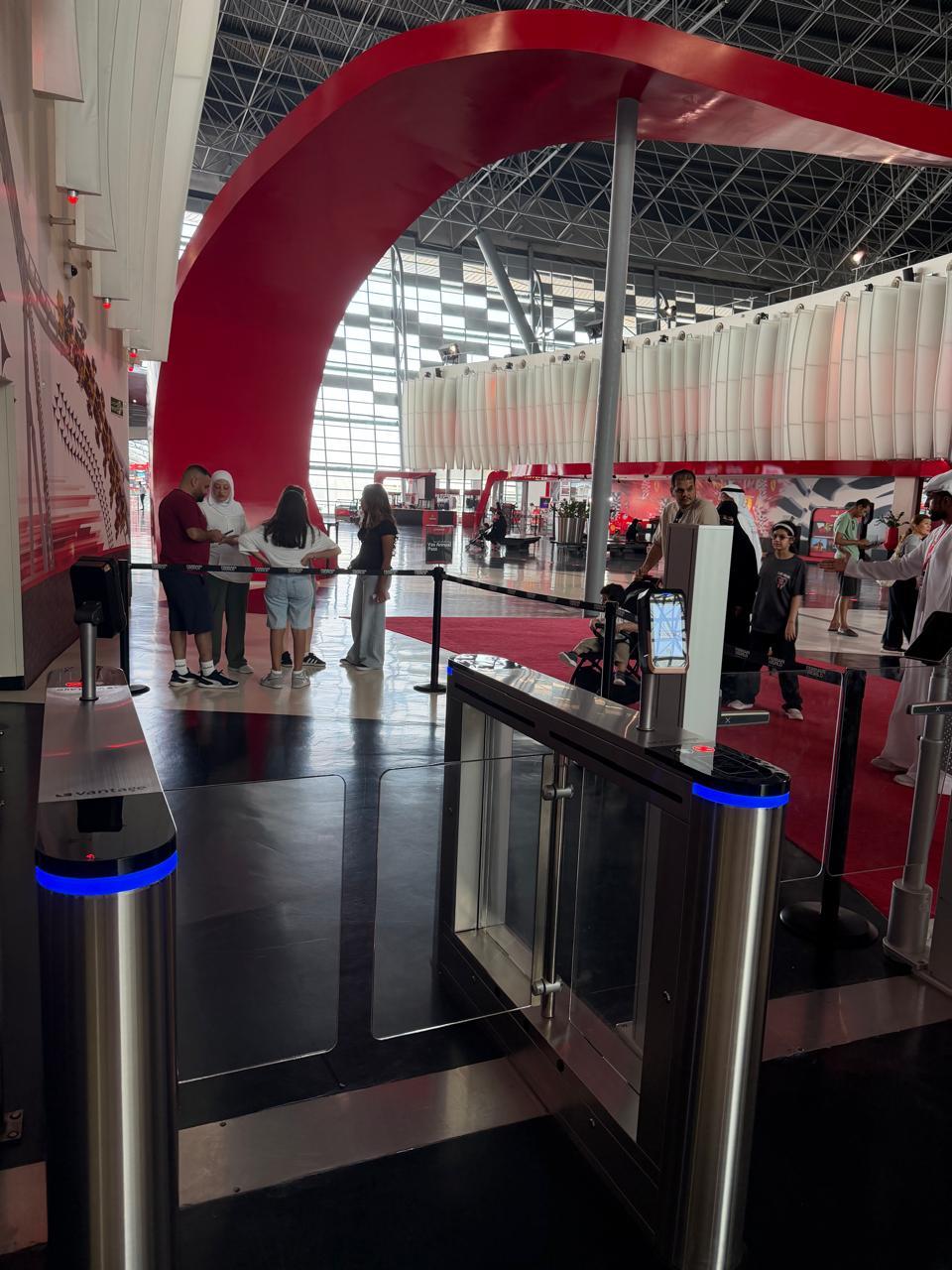
Vantage swing barrier gates at the Ferrari World Abu Dhabi entrance, where families arrive with prams and bags.
How much lobby width does each type need?
Add the lane widths to the cabinet widths. A bank of gates always has one more cabinet than it has lanes, so a four-lane bank has five cabinets, and the cabinet width decides how much of the lobby the bank takes.
Single core & double core cabinets
This is where the SC and DC in Vantage model codes come in. A single core (SC) cabinet carries one barrier and sits at the end of a bank. A double core (DC) cabinet carries two, one for the lane on each side, and sits between lanes. A four-lane bank is two SC cabinets and three DC cabinets.
Four-lane bank widths compared
| Model | Type | Lane width | Cabinet width | Four standard lanes, overall width |
|---|---|---|---|---|
| V-PM4730SC/DC-SGT3 | Swing barrier | 600 mm | 110 mm | 2,950 mm |
| VP-PM5030SC/DC-SGT3 | Speed gate | 600 mm | 150 mm | 3,150 mm |
| V-PM4240SC/DC-SGT3 | Swing barrier | 600 mm | 160 mm | 3,200 mm |
| V-PM4200SC/DC-SGT3 | Swing barrier | 600 mm | 185 mm | 3,325 mm |
| V-PM4700SC/DC-SGT3 | Swing barrier | 600 mm | 200 mm | 3,400 mm |
| V-PM3440SC/DC-FBT3 | Flap barrier | 550 mm | 300 mm | 3,700 mm |
| VP-PM5020SC/DC-SGT3 | Speed gate | 600 mm | 300 mm | 3,900 mm |
The flap barrier has the narrowest lane but some of the widest cabinets, because its flaps fold back into them. That is why four 600 mm lanes of slim swing barriers can take less lobby width than four 550 mm lanes of flap barriers. Two lanes of V-PM4200 work out the same way: 185 + 600 + 185 + 600 + 185 = 1,755 mm.
Length, queue space & floor
Three more measurements belong on the layout plan:
- Length: Most cabinets are 1,200 to 1,500 mm long. The VP-PM5110 swing barrier is 2,850 mm long and 1,400 mm tall, so it needs a deep lobby.
- Queue and landing: Leave room in front of the readers for the queue, and a clear landing beyond the gates so people do not step straight into a corridor.
- Floor: Speed gate cabinets weigh 95 to 180 kg each, and the VP-PM5030 is fixed with M12 x 90 mm expansion bolts. Plan the slab, the fixings and the cable ducts between cabinets before the floor finish goes down.
Which barrier gates can be installed outdoors in the Gulf?
Heat is rarely the limit; water and dust are. Most Vantage flap, swing and speed gates are rated to work from -25°C or -20°C up to 70°C, but most carry IP44 to IP54, which suits a lobby or a covered entrance rather than open weather.
Models for semi-open entrances
For an entrance that is semi-open or exposed, look for:
- V-PM3400SC/DC-FBT3 flap barrier: IP54 as standard, IP56 as an option, and a fully welded top cover designed for outdoor use.
- V-PM4700SC/DC-SGT3 and V-PM4200SC/DC-SGT3 swing barriers: IP54 as standard, with IP56 as an option.
- 316 grade stainless steel: Offered as an option on the V-PM3400, V-PM3410, V-PM4700, V-PM4200, VP-PM5020 and VP-PM4220-SGP1T3, and as 316L on the V-PM3440 and V-PM4050AF. It resists corrosion better than the standard 304 grade near the coast.
- V-PM7000SC-FSGT3 full height swing gate: IP65 for open perimeters, though it is rated to 55°C, so a canopy is still worth having in a Gulf summer.
Models for indoor lobbies
Speed gates are IP44 across the Vantage range, and their glass panels and the marble top of the VP-PM5030 belong indoors. The V-PM4000 P type swing gate is also rated to 55°C, and benefits from shade or a canopy outdoors. The aluminium V-PM4730 (IP41) and the V-PM4050AF P type gate (IP40) are built for indoor lobbies.
What happens in a fire alarm or a power cut?
That depends on whether the gate is set to fail safe or fail lock. Fail safe releases the barrier so people can walk out; fail lock holds it shut. Most Vantage flap and swing models can be set either way, while the VP-PM5030 and VP-PM5020 speed gates are fail safe only.
Fire alarm integration
Fire alarm integration is supported on almost all Vantage entrance gate models. When the fire alarm input is triggered, the gates give free passage for evacuation.
Which setting to choose
Choose fail safe for any lane on an escape route, which in an office lobby is usually every lane. Fail lock suits a lane guarding a restricted area that has another exit, where a gate without power must not become an open door. Either way, wire the fire alarm signal to the gates themselves rather than relying on software, so the lanes open even if the network is down.
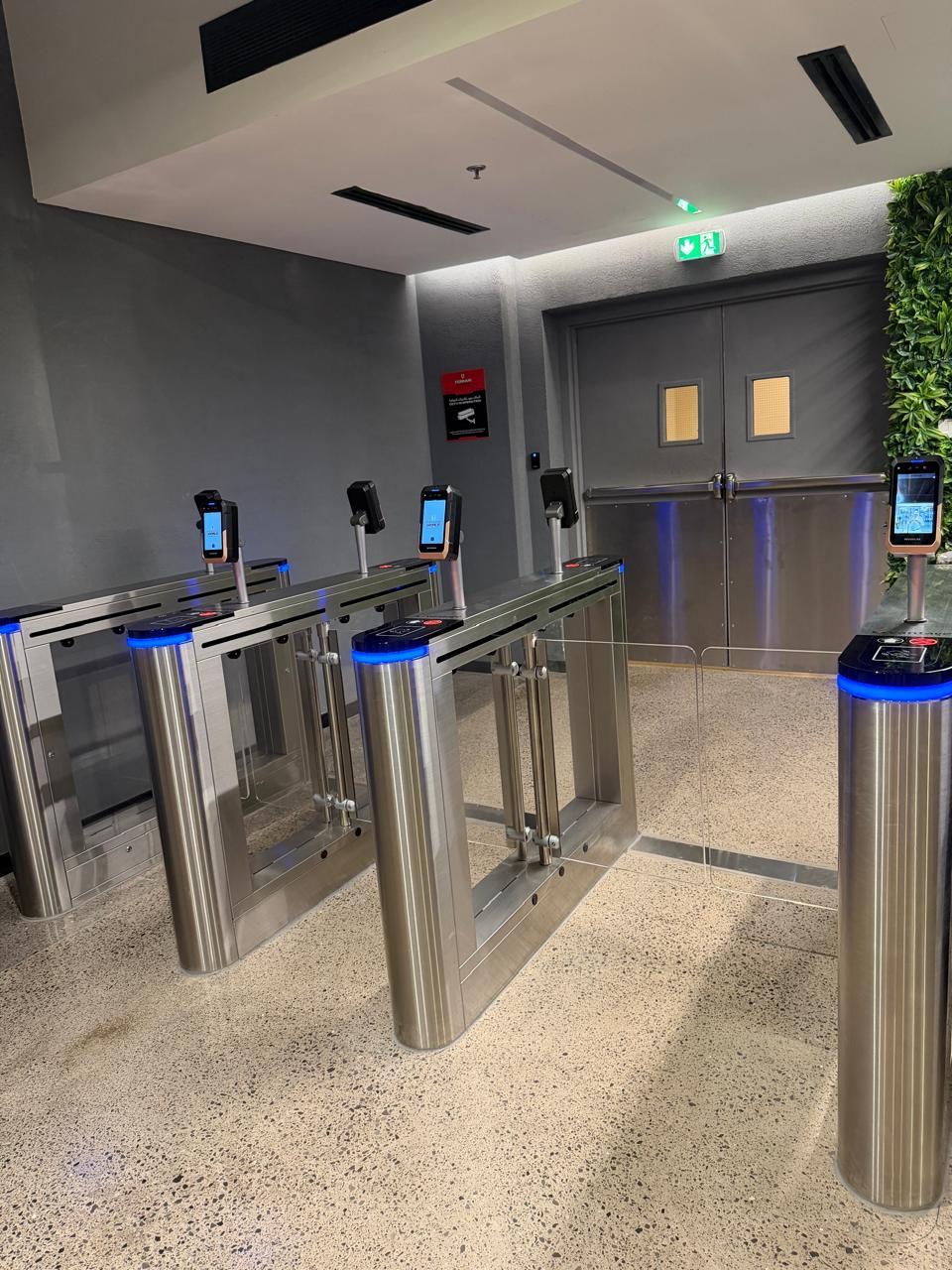
Swing barrier lanes with face recognition readers beside an emergency exit. Lanes on an escape route should be set to fail safe.
Which gate suits which site?
Flap barriers suit offices, hotels and hospitals that want one person per credential through a narrow lane. Swing barriers suit leisure and mixed traffic, where prams, wheelchairs and bags are normal. Speed gates suit headquarters and utilities that want tall glass and closer sensing in a premium lobby.
Where each type is installed
Vantage installations across the region show where each type fits:
- Hotels and landmark buildings: Burj Al Arab, Madinat Jumeirah and 25 Hours Hotel in the UAE use Vantage flap gate barriers, and the Hilton Hotel in the UAE uses swing gate barriers.
- Offices and financial services: Walaa Insurance, Tabby and Jahez Group in Saudi Arabia, and Two Four 54 and Al Baraka Holding in the UAE, use flap gate barriers. Al Rajhi Bank in Saudi Arabia and Schneider Head Office in the UAE combine flap and swing gate barriers.
- Healthcare and education: King Faisal Hospital in Saudi Arabia and the American University of Ras Al Khaimah use flap gate barriers, and Mohammed Bin Zayed University uses swing gate barriers.
- Theme parks and leisure: Ferrari World, Warner Bros World, Yas Water World, Sea World and teamLab Phenomena in the UAE use swing gate barriers, where families arrive with prams and bags. The Dubai Mall Ice Rink combines flap and swing gate barriers.
- Sport: The Khalifa International Tennis and Squash Complex in Qatar uses swing gate barriers, and the Fatima Bint Mubarak Ladies Sports Academy in the UAE uses flap gate barriers.
- Transport and logistics: Al Maktoum Airport uses flap gate barriers, and AD Ports Group and Zajel Logistics use swing gate barriers.
- Utilities: Abu Dhabi Power Corporation in the UAE and the Office 1991 Building in Oman use Vantage speed gates.
- Events: The Sheikh Zayed Festival in the UAE uses Vantage flap gate barriers at its ticketed entrances.
Vantage flap barrier gates scanning tickets at the Sheikh Zayed Festival in the UAE.
When a turnstile is the better choice
Where the entrance is outdoors and unattended, or the risk is high enough that climbing over matters, none of the three is enough. That is the job of turnstiles, and the full height turnstiles guide covers single and dual lane options.
What should the specification include?
Before you sign off a flap barrier, swing barrier or speed gate specification, confirm that each item below is written into it rather than assumed. Most problems after handover trace back to one of them.
- Lane count: Sized to the busiest 15 minutes at a working rate of about 30 people a minute per lane.
- Wide lane: At least one lane of 900 mm or more, placed where reception or security can see it.
- Bank width: Lanes plus one more cabinet than there are lanes, checked against the lobby plan.
- Barrier height: Agreed against the risk, from hip height flaps and doors to 1,200 to 1,800 mm glass.
- Location: Ingress rating and stainless steel grade matched to the site, such as IP56 and 316 grade for a semi-open or coastal entrance.
- Emergency mode: Fail safe or fail lock decided lane by lane, with the fire alarm signal wired to each gate.
- Readers: Reader type agreed and its connection checked. The Vantage range accepts any RFID or biometric reader through a normally open (NO) input, with RS485 on many models, so face and fingerprint readers and RFID cards work alike.
- Lane behaviour: Entry, exit or both directions set for each lane, and the passing time before the lane closes again, 5 seconds by default and adjustable on most models.
- Floor: Slab, fixings and cable ducts between cabinets planned before the floor finish.
Model specifications in this guide are taken from Vantage product specifications as of October 2026.
Frequently asked questions
What is the difference between a flap barrier and a swing barrier?
A flap barrier closes the lane with two short flaps that retract into the cabinets, usually in a 550 mm lane. A swing barrier closes it with doors that swing clear of the lane, usually in a 600 mm lane with a 900 mm option and on slimmer cabinets, which makes it the better choice for mixed traffic and accessible lanes.
Is a speed gate faster than a flap barrier?
Generally, no. A speed gate is faster than a tripod or full height turnstile, which is where the name comes from, but it moves people at much the same rate as a flap barrier. In the Vantage range both are rated at 35 to 40 people a minute. A speed gate is chosen for its taller glass panels, closer sensing with 9 to 12 pairs of infrared sensors, and longer service life.
Which barrier gate is best for wheelchair users?
A swing barrier or speed gate with a 900 mm lane, or a P type or post-type swing gate such as the VP-PM4220-SGT3 or V-PM4050AF-SGT3, because the door clears the lane completely. Some flap barriers also reach 900 mm with telescopic flaps. Every bank of gates should include at least one wide lane.
Can flap barriers and swing barriers be installed outdoors?
Only models with a higher ingress rating should be. Most Vantage flap and swing barriers are rated IP44 to IP54 for indoor and covered entrances. For semi-open sites, the V-PM3400 flap barrier offers IP56 with a welded top cover and the V-PM4700 and V-PM4200 swing barriers offer IP56, ideally specified in 316 grade stainless steel.
What happens to barrier gates during a fire alarm?
On models with fire alarm integration, the gates release and give free passage for evacuation when the alarm signal is received. Most Vantage flap and swing barriers can be set to fail safe or fail lock when power is lost.
How much space does a bank of barrier gates need?
Add the lane widths to the cabinet widths, remembering that a bank always has one more cabinet than it has lanes. Four 600 mm swing barrier lanes on 110 mm cabinets need 2,950 mm, while four 550 mm flap barrier lanes on 300 mm cabinets need 3,700 mm.
What do SC and DC mean in a barrier gate model code?
SC means single core and DC means double core. A single core cabinet carries one barrier and sits at the end of a bank, while a double core cabinet carries two, one for each neighbouring lane, and sits between lanes. A four-lane bank is two SC cabinets and three DC cabinets.
Choosing between flap barriers, swing barriers & speed gates
Start with the people, not the gate. Count the busiest 15 minutes and size the lanes to a realistic rate. Decide who needs the wide lane and where it can be seen. Measure the lobby and do the cabinet arithmetic. Then let the location and the risk choose the rest: a flap barrier for a narrow, one at a time lane indoors, a swing barrier where prams, wheelchairs and bags are normal or the lobby is tight, and a speed gate where a premium lobby needs taller glass and closer sensing. If two options still look equal, choose the one that fails safe on the escape route and is rated for the place it will stand.