Full Height Turnstiles: Single Lane and Dual Lane with 3-Arm and 4-Arm Rotors
September 7, 2026
A full-height turnstile is the most physically uncompromising piece of pedestrian access control you can specify. It runs floor to ceiling, it cannot be climbed over or crawled under, and it works without a guard present. That is why it appears at refinery gates, substation perimeters, labour accommodation, fabrication yards, industrial and depot entrances across the Gulf region and across the world.
The difficulty comes at the specification stage. Two datasheets can look almost identical, both quoting stainless steel, IP weatherproof and 100 per cent duty cycle, yet deliver very different throughput and very different anti-tailgating behaviour. The two specifications that drive that difference are lane count and rotor configuration, and both are routinely misread.
This guide explains how to read those two figures, what each configuration is genuinely good at, and how the multiple options of full-height turnstile models in the Vantage range compare on the numbers that matter.
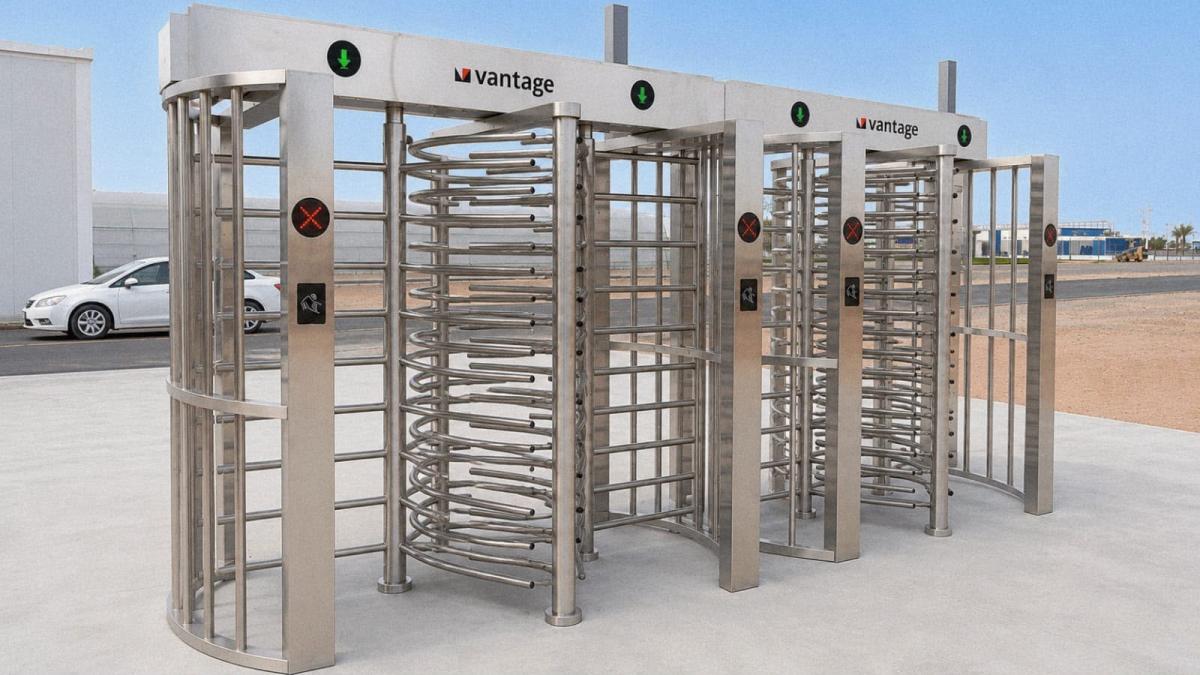
What is a full height turnstile
A full height turnstile is a rotating barrier enclosed within a fixed frame that extends the full height of the passage, typically around 2,250 mm. A person presents an authentication credential, the rotor unlocks, they push through one compartment, and the rotor locks again behind them. One credential, one rotation, one person.
The contrast with waist-high equipment matters. A tripod turnstile stops at hip level and controls flow rather than preventing determined access, because a person can vault it. A speed gate or flap barrier manages high-volume movement in a supervised lobby, relying on sensors and an alarm rather than physical prevention. A full-height turnstile physically prevents unauthorised passage, which is why it is the default at unmanned perimeters where nobody is watching the gate.
That physical certainty is the whole point. It is also why full-height units are heavier, need a proper foundation, and are specified differently from anything else in the entrance management family.
Reading the rotor specification: sectors versus arms
This is the single most misread line on a full-height turnstile datasheet, and it causes more specification confusion than any other.
A datasheet will often state two things that appear to contradict each other. It will say the rotor is 3 arms at 120-degree stop and then separately state that there are 10 numbers of arms for full height. Buyers reasonably ask whether the unit has three arms or ten.
It has both, because the two figures describe different things.
- The sector count and stop angle, written as 3 × 120 degrees or 4 × 90 degrees, describes how the rotor is divided when you look down on it in plan view. Three sectors of 120 degrees make one full rotation. Four sectors of 90 degrees also make one full rotation. This number tells you how far the rotor turns per person and how large each compartment is.
- The arm count, typically 10 on a full-height unit, describes the horizontal bars stacked vertically within each sector to make up the full height of the barrier. This number tells you nothing about passage geometry. It is a construction detail.
So a rotor described as 3 × 120 degrees with 10 arms has three compartments in plan, each made of ten stacked horizontal bars. Once you separate the two figures, the comparison between models becomes straightforward.
Three-arm versus four-arm rotor: the trade-off
Once you can read the rotor line, the choice between a three-sector and a four-sector rotor becomes a security decision rather than a technical detail.
Three sectors at 120 degrees
A three sector rotor gives each person a wider compartment and a wider passage aperture. The person turns through a larger arc but moves through a more open space, which suits sites where people carry tools, wear bulky protective equipment or move with kit bags. Industrial and construction environments generally favour this configuration for that reason.
In the Vantage range, V-PM2200 and V-PM2400 and some other models use a three-sector 120-degree rotor.
Four sectors at 90 degrees
A four sector rotor creates a smaller compartment. Less physical space per rotation means less room for a second person to attempt to share a passage, which tightens anti-tailgating control. It suits controlled headcount environments where the priority is certainty about how many people passed, rather than accommodating people carrying equipment.
In the Vantage range, V-PM2300 and V-PM2900DL and some other models use a four-sector 90-degree rotor.
Neither configuration is superior in the abstract. The question is whether the site prioritises comfortable passage for people carrying equipment or the tightest possible one-person-per-cycle enforcement.
Single lane and dual lane
Lane count is the specification that most directly determines whether a gate will cope at peak. It is also the one most often confused with direction of travel, so it is worth separating the two before looking at the numbers.
Every model runs in both directions
Lane count does not decide whether people can go in and out. Every full-height turnstile in the range supports bidirectional operation, including the single-lane models. V-PM2200 supports single and bidirectional operation with passage control in one or either direction. V-PM2100 offers four selectable operating modes: single direction, bidirectional, always free and always locked. Always free and always locked are useful at perimeter gates, allowing free egress outside working hours or a full lockdown during an incident.
So the question is never whether a unit can handle two-way traffic. It is whether that traffic needs to move at the same time.
The real difference: sequential or simultaneous
A single-lane unit has one rotor. Running bidirectionally, a person entering and a person leaving both use that same rotor, so they take turns. Movement in both directions is fully supported, but it happens sequentially.
A dual-lane unit has two independent rotors within one frame. Entry and exit can run at the same time without either queue waiting on the other. Both lanes can also be set to run the same direction during a one-directional surge, such as at the end of shift.
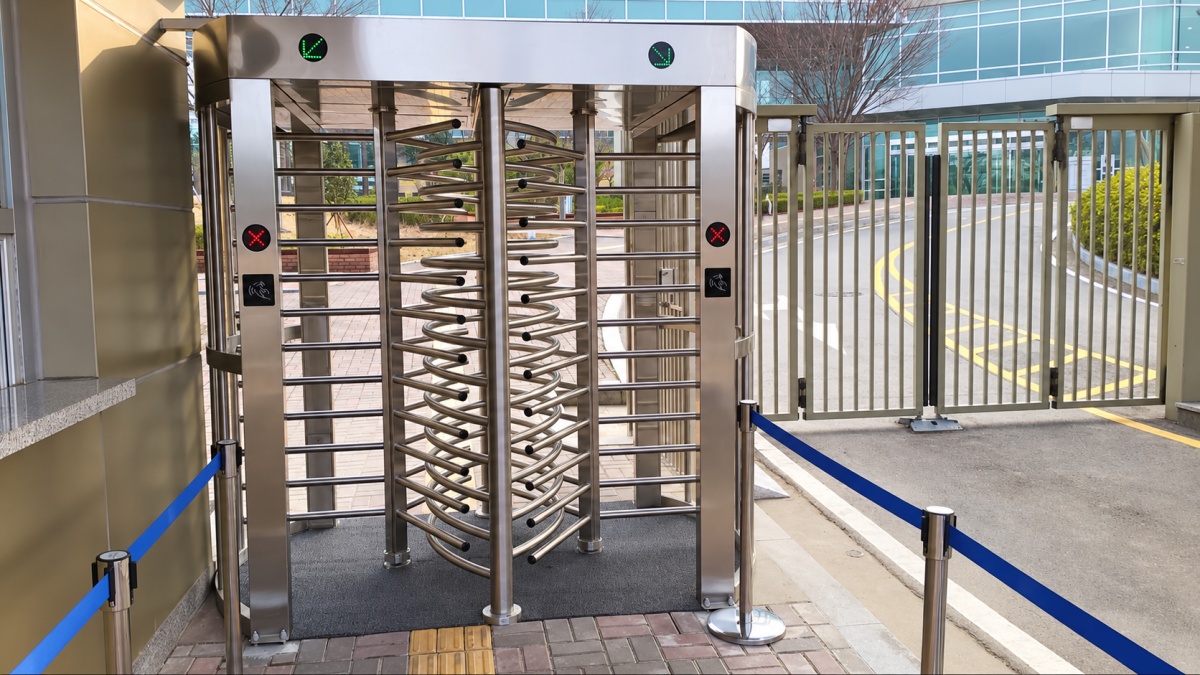
The throughput arithmetic
Published throughput across the Vantage full height range works out as follows.
- V-PM2100 handles around 15 persons per minute, roughly one person every four seconds. This suits low-traffic perimeter points, back gates and secondary access.
- V-PM2200 handles up to 30 persons per minute in a single lane, roughly one person every two seconds.
- V-PM2300 and V-PM2400 handle up to 30 persons per minute per lane. As dual lane units give 60 persons per minute across both lanes, or 3,600 per hour.
- V-PM2900DL handles 20 to 30 persons per minute per lane, giving 40 to 60 across both lanes.
The practical test is the shift change, not the daily average. A fabrication yard with 600 workers arriving inside a twenty-minute window needs 30 people per minute of sustained capacity. A single-lane unit at 30 per minute meets that only if nobody hesitates, nobody presents a failed credential and nothing queues. In practice a site of that size specifies dual lane or multiple units so that one slow passage does not stall the entire gate.
Footprint and the cost of the decision
Dual lane costs footprint and weight. Within the range, V-PM2300 occupies 2100 × 1200 mm and V-PM2400 occupies 2400 × 1500 mm, against 1400 × 1200 mm for the single lane V-PM2100. Weight rises accordingly, which affects foundation design and installation planning.
Full-height turnstile comparison
Other than the models mentioned below, Vantage also offers several other custom models for special applications as per project requirements.
| Specification | V-PM2100 | V-PM2200 | V-PM2300 | V-PM2400 | V-PM2900DL |
|---|---|---|---|---|---|
| Lanes | Single | Single | Dual | Dual | Dual (also available in single lane configuration) |
| Rotor type | 3 arms, 120° stop | 3 arms, 120° stop | 4 arms, 90° stop | 3 arms, 120° stop | 4 arms, 90° stop |
| Arms making up height | 10 | 10 | 10 | 10 | 10 |
| Passage width | 550 mm | 650 mm | 550 mm | 650 mm | 600 mm |
| Throughput | Up to 15 per min | 30 per min per lane | 30 per min per lane, 60 total | 30 per min per lane, 60 total | 20 to 30 per min per lane |
| Drive | Electro-magnetic DC | Semi-automatic electro-mechanical | Electro-mechanical DC motor | Electro-magnetic DC | Electro-magnetic DC with anti-burn solenoid |
| Duty cycle | 100% | 100%, 3 million plus cycles | 100% | 100%, 5 million plus cycles | 100%, 5 million plus cycles |
| Operating temperature | -25 to +70°C | -15 to +55°C | -15 to +55°C | -15 to +55°C | -20 to +70°C |
| Ingress protection | IP54, IP56 optional | IP54, IP56 optional | IP54, IP55 optional | IP54, IP55 optional | IP54 |
| Material | AISI 304, 316 optional | SS304, 316 optional | SS304, 316 optional | SS304, 316 optional | SUS304, SS316L optional |
| Fire alarm integration | Supported | Supported | Supported | Supported | Supported |
| Reader integration | Supported | Supported | Supported | Supported | Supported |
| Power consumption | 35 W | 30 W | 30 W | 30 W | 50 W |
| Dimensions in mm | 1400 × 1200 × 2250 | 1600 × 1500 × 2250 | 2100 × 1200 × 2250 | 2400 × 1500 × 2250 | 2200 × 1350 × 2200 |
| Weight | 150 kg net | 160 kg net | 360 kg gross | 280 kg gross | 380 kg gross |
| Certifications | CE, FCC, RoHS | CE, FCC, RoHS | CE, FCC, RoHS | CE, FCC, RoHS | CE, FCC, RoHS |
Specifications are subject to change and may vary by region. Weights and measurements are approximate.
In the field: over 300 entrance gate projects delivered in the GCC region
Specification decisions are easier to judge against a real installation.
Vantage deployed six V-PM2400-FTST3 dual-lane full-height turnstiles at Denholm Yam's fabrication facility in Abu Dhabi's industrial area. Six dual-lane units mean twelve independently controlled lanes at a single site, with factory-fitted card readers integrated into the units.
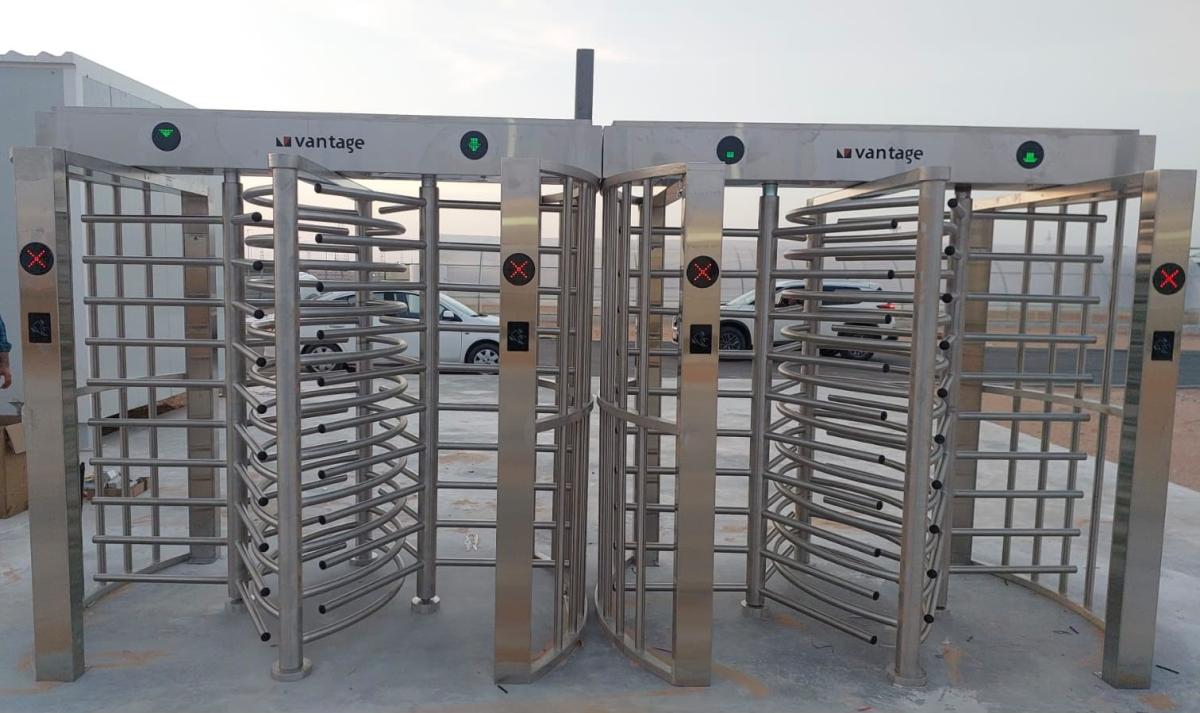
The requirement was single file, one person per cycle passage across every lane. In a fabrication environment that requirement is not only about security. Accurate headcount at the gate underpins site safety, because in an evacuation the muster list has to match the number of people who actually passed through the perimeter.
The specification choices are worth reading against the guidance above. Dual lane was chosen so that entry and exit can run simultaneously at shift change rather than taking turns through a single rotor. The three sector 120 degree rotor on the V-PM2400 gives the wider compartment that suits workers carrying tools and wearing protective equipment. The units are installed outdoors on a concrete pad in an industrial setting, which puts the environmental specification, material grade and ingress protection rating in the front line.
Other than this, Vantage full height turnstiles were the preferred choice for multiple other prestigious projects such as Tabuk Pharma facility in Saudi Arabia, VERTIV factory in UAE, Ras Al Khaimah Port and Airport, Kuwait National Guard, MAERSK Shipping Lines ports in Nigeria, HH Sheikh Mohammed's staff accommodation in UAE, Petroleum Development Oman and several more.
When a full height turnstile is the right choice
Full height is not automatically the correct answer. It is the correct answer under specific conditions.
Specify full height when
- The entry point is unmanned, or manned only part of the time.
- The perimeter must be physically secure rather than monitored, so an alarm on tailgating is not sufficient.
- Accurate headcount is required for safety mustering or contractor management.
- The installation is outdoors and exposed.
- The site is industrial, with people carrying tools or wearing protective equipment.
Consider a speed gate or flap barrier instead when
- The entrance is a supervised reception or lobby where appearance matters.
- Throughput requirements are very high and reception staff are present to resolve exceptions.
- An accessible wide lane is needed for wheelchair users, or for visitors with luggage or trolleys.
Consider a tripod turnstile instead when
- The requirement is orderly flow control rather than physical prevention.
- The installation is indoors and within sight of staff.
- Space or budget will not accommodate a full height frame.
Many sites use a combination. A full height unit on the unmanned perimeter gate, tripod turnstiles at an internal boundary, and a swing gate alongside for accessible passage and equipment movement.
Specification checklist for projects
Beyond lane count and rotor type, these are the specifications that determine whether a full height turnstile performs over its service life.
Material grade
SS304 is standard across the range with SS316 or SS316L available as an option on every model. For coastal installations, or any site exposed to salt laden air, the upgrade is worth specifying at order rather than discovering the need later. Inland industrial sites are generally well served by 304. Powder coating with customised RAL colour options is also available for all Vantage turnstile gates.
Ingress protection
Most Vantage models are IP54 as standard. IP56 is optional on V-PM2100 and V-PM2200, and IP56 is optional on V-PM2300 and V-PM2400. IP54 protects against dust ingress and splashing water. The step up matters for sites subject to washdown, driven sand or heavy dust loading.
Operating temperature
Check the rated ceiling against realistic site conditions rather than shaded ambient. An unshaded steel structure in direct sun in July and August runs considerably hotter than the published air temperature, and a canopy over the unit is worth considering regardless of the rating.
Fail-safe versus fail-lock
This decides what happens when power is lost. Fail-safe releases the rotor to free movement, which is required for evacuation routes. Fail-lock holds the rotor locked, which suits high security perimeters where an unattended open gate is unacceptable. V-PM2300, V-PM2400, V-PM2900DL and V-PM2900SL all support both modes as a selectable configuration. Confirm which mode the fire strategy for your site requires before installation, because it is a commissioning decision with life safety implications.
Reader integration
All models integrate with RFID and biometric readers. Factory fitted inbuilt card readers are available as an option, as supplied with many of our project installations, which removes the need for separate reader pedestals and simplifies cable routing and civil work.
Frequently asked questions
How many people per minute can a full height turnstile handle?
Between 15 and 35 persons per minute per lane depending on the model. A dual lane unit running at 30 per minute per lane gives 60 persons per minute in total. Actual sustained throughput depends on how quickly people present credentials and whether the passage is bidirectional.
What is the difference between a three-arm and a four-arm turnstile rotor?
A three arm rotor turns 120 degrees per person and gives a wider compartment, which suits people carrying tools or wearing protective equipment. A four arm rotor turns 90 degrees per person and gives a smaller compartment, which tightens anti-tailgating control. Both complete one full 360 degree rotation.
Do I need single lane or dual lane?
Both handle two-way traffic, so this is not a question of direction. A single lane unit runs bidirectionally but entry and exit share one rotor and take turns. A dual lane unit has two independent rotors, so entry and exit move at the same time. Choose single lane where peak flow stays within 30 to 35 persons per minute and traffic is mostly one direction at a time. Choose dual lane where entry and exit overlap, or where a single slow passage would stall the queue.
Can a single lane full height turnstile work in both directions?
Yes. Single lane models support bidirectional operation. V-PM2100 additionally offers four selectable modes: single direction, bidirectional, always free and always locked. The limitation is not direction but simultaneity, since both directions share the same rotor and pass sequentially.
Can a full height turnstile be installed outdoors?
Yes. All Vantage models are rated IP54 as standard with higher ratings optional, and are supplied in stainless steel with a 316 grade option. Check the operating temperature rating against site conditions and consider a canopy for unshaded installations.
What happens to a full height turnstile in a fire?
Models supporting fail-safe operation release the rotor to free movement when power is lost or when the fire alarm is triggered, allowing unobstructed evacuation. This is a configurable setting and must be aligned with the site fire strategy at commissioning.
Can a full height turnstile be integrated with an existing access control system?
Yes. All models accept credential input from RFID, QR and biometric readers. Factory fitted inbuilt readers are available as an option.
Getting the specification right
Lane count and rotor configuration are the two decisions that determine whether a full height turnstile serves the site or frustrates it. Get the lane count right and the gate clears at shift change. Get the rotor right and people pass comfortably while the headcount stays accurate.
Everything else, material grade, ingress protection, temperature rating and fail mode, is about whether the unit is still performing in five years. In Gulf conditions those specifications are not optional detail.