Turnstile Gate Buyer’s Guide
July 24, 2026
Choosing a turnstile gate looks simple until you sit down with the datasheets. Passage widths, rotor configurations, duty cycles, ingress protection ratings, fail safe versus fail lock behaviour: every specification changes how the gate performs at your entrance, and the wrong choice shows up quickly as queues at shift change or a security gap at an unmanned perimeter.
This guide walks through the decision the way a security consultant would. It explains the difference between full height and half height turnstiles, the specifications that actually matter for facilities in the Middle East, GCC, and Africa, and how to match a turnstile entry system to your site.
Table of contents
- What is a turnstile gate and where does it fit in access control?
- Full height vs half height turnstiles: the first decision
- Seven specifications to check before you buy
- Vantage full height turnstile range at a glance
- Vantage half height tripod turnstile range at a glance
- Matching the turnstile to the facility
- Integration: readers, controllers, and fire systems
- Buying checklist for MEA and GCC projects
- Why source turnstiles from Vantage Security
- Frequently asked questions
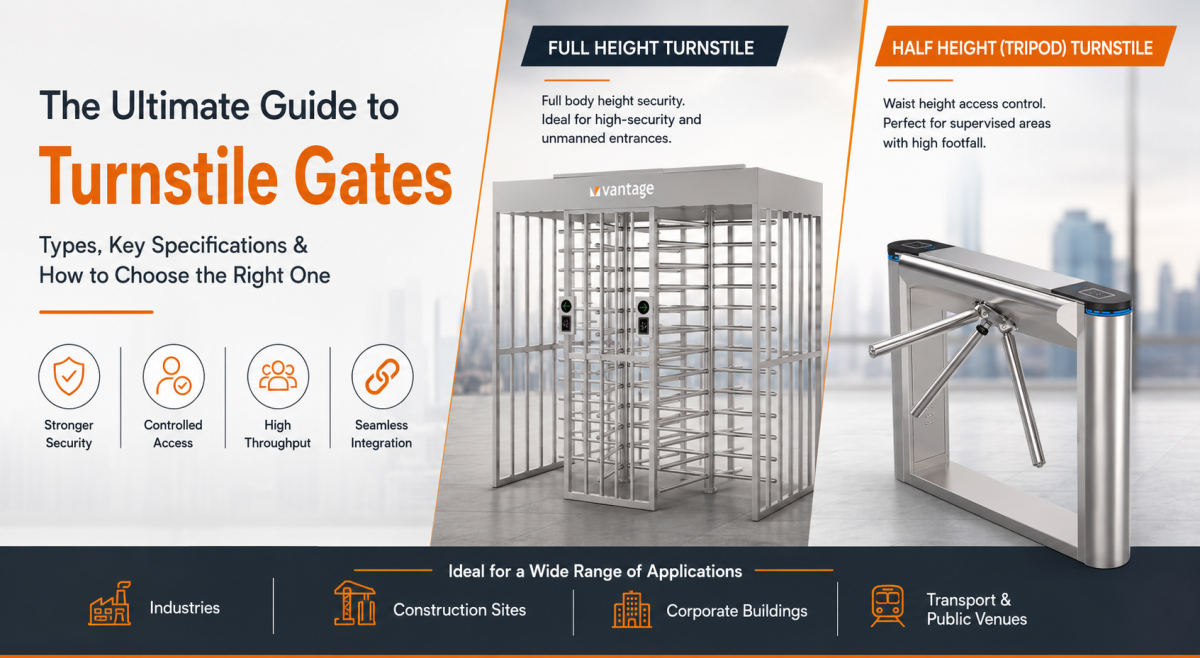
What is a turnstile gate and where does it fit in access control?
A turnstile gate is a physical barrier that enforces one-person-per-credential entry. Unlike a standard door with a card reader, a turnstile makes tailgating physically difficult: the rotor or arm only releases one passage per valid signal. That signal can come from any RFID card reader, biometric terminal, QR scanner, or push button, because industrial turnstiles accept a simple dry contact (NO) input from compatible readers.
In a layered security design, turnstiles sit at the throughput layer. Perimeter fencing and gates control vehicles, CCTV provides monitoring, and the turnstile is the point where each individual person is counted, authenticated, and physically admitted or refused. That is why turnstile entry systems are standard at construction sites, factories, labour accommodation, metro stations, stadiums, and corporate lobbies across the GCC.
Full height vs half height turnstiles: the first decision
Every turnstile purchase starts with the same question: does the barrier need to stop a determined adult from climbing over it? If yes, you need a full height turnstile. If supervised deterrence is enough, a half height tripod turnstile is faster, smaller, and easier to install.
| Factor | Full height turnstile | Half height tripod turnstile |
| Security level | Highest: cannot be climbed or jumped | Deterrent: best used at supervised entrances |
| Typical height | Approx 2,250 mm full body barrier | Approx 960 to 1,020 mm waist level |
| Throughput per lane | Approx 30 to 50 persons per minute | Approx 30 to 40 persons per minute |
| Footprint | Larger; dual lane frames from approx 2,100 mm wide | Compact; bridge units from 480 mm deep |
| Supervision needed | Can run unmanned 24/7 | Can run unmanned or paired with reception or guard |
| Typical GCC sites | Construction sites, plants, labour camps, perimeters for high security sites, embassies | Offices, gyms, metro, stadiums, lobbies |
A useful rule of thumb: full height turnstiles secure unmanned or high-risk entrances, while half height tripod turnstiles manage flow or visitors at entrances such as offices, gyms etc. Many sites combine both, with full height units on the perimeter and tripods inside the lobby.
Seven specifications to check before you buy
1. Throughput rate
Throughput is stated in persons per minute per lane. Vantage full height gates handle 30 persons per minute per lane on standard models, rising to 35 to 50 persons per minute per lane on the heavy-duty V-PM2400. Half height tripods run 30 to 40 persons per minute. To size an entrance, take your peak headcount and the window in which they arrive: 500 workers arriving over 15 minutes need at least 34 persons per minute of combined capacity, which means two lanes minimum with headroom for badge fumbles.
2. Passage width
Standard passage width is 550 mm across most models, with 600 to 650 mm available on selected full height gates such as the V-PM2900DL (600 mm), V-PM2400 (650 mm) and V-PM2200 (650 mm). Wider passages ease movement for workers carrying tools or bags. Sites that must accommodate wheelchairs or trolleys should pair turnstiles with a separate supervised access gate, since turnstile lanes are designed for single pedestrians. Also passage width can be customised for special case requirements.
3. Rotor configuration
Full height rotors come in two geometries: 3 arms at 120 degree stops, or 10-arm barriers with 4 by 90 degree locking positions. The 90 degree configuration creates a tighter compartment per rotation and is the higher security choice, used on the V-PM2900DL and V-PM2300. The 120 degree configuration, used on the V-PM2400 and V-PM2200, gives a more open passage feel with faster flow.
4. Ingress protection and operating temperature
This is where buying for the GCC and Africa differs from buying for Europe. An outdoor turnstile at a Gulf construction site faces dust, wind-driven sand, occasional driving rain, and surface temperatures well beyond the air temperature. Look for IP54 as the outdoor baseline, with IP55 or IP56 optional upgrades on several Vantage models. Operating temperature ranges on the Vantage range extend from -25°C to +70°C on models like the V-PM2100 and the tripod line, which comfortably covers Gulf summers. Indoor lobby installations can accept IP44-rated models such as the motorized V-PM1800M.
5. Material grade
AISI 304 stainless steel is the standard chassis material across the Vantage range, with SS316 or SS316L available as an optional upgrade. Specify 316 grade for coastal and marine environments such as ports, offshore facilities, and waterfront developments, where chloride exposure corrodes 304 grade over time.
6. Fail safe vs fail lock behaviour
What should the gate do when power fails? Fail safe means the rotor spins freely so people can exit; fail lock means it locks in the home position to keep the perimeter sealed. Vantage turnstiles support selectable fail safe or fail lock per direction, and every model in the range supports fire alarm integration to provide free passage for evacuation. Half height tripods add a drop arm option, where the horizontal arm drops to create an open passage in an emergency. Confirm your civil defence requirements before configuring this: evacuation routes typically must be fail safe.
7. Service life and duty cycle
A turnstile at a labour camp gate can see several thousand rotations a day. Check the rated service life: Vantage tripod turnstiles are rated for more than 5 million operation cycles, and the motorized V-PM1800M is rated for 10 million. Full height models like the V-PM2900DL are designed for 100 percent duty cycle operation, meaning continuous use without a rest period.
Vantage full height turnstile range at a glance
The full height line covers single and dual lane configurations. Dual lane gates share one frame between two independent passages, which lowers the installed footprint per lane and suits high-volume perimeter entrances.
| Model | Lanes | Passage width | Throughput | Rotor | IP rating | Operating temp |
| V-PM2900DL-FTST3 | Dual | 600 mm | 35 to 50 ppm/lane | 10 arms, 4x90° | IP54 | -20°C to +70°C |
| V-PM2400-FTST3 | Dual | Up to 650 mm | 30 ppm/lane | 3x120° stop | IP54 (IP55 opt) | -15°C to +55°C |
| V-PM2300-FTST3 | Dual | 550 mm | 30 ppm | 4x90° stop | IP54 (IP55 opt) | -15°C to +55°C |
| V-PM2100-FTST3 | Single | 550 mm | Up to 15 ppm | Full height rotor | IP54 (IP56 opt) | -25°C to +70°C |
| V-PM2200-FTST3 | Single | 650 mm | 30 ppm | 3 arms, 120° stop | IP54 (IP56 opt) | -15°C to +55°C |
All full height models are CE, FCC, and RoHS certified, integrate with any RFID or biometric reader through NO input, and carry red and green LED direction indicators. The V-PM2900DL adds a covered roof passage and an anti-burn solenoid for continuous operation, while the V-PM2200 features a self-centering mechanism with hydraulic damping for smooth, quiet rotation and a rotor shaft rated beyond 3 million cycles.
Vantage half height tripod turnstile range at a glance
The tripod line runs from compact bridge-style units for lobbies and gyms to dual lane pedestals that control two passages from a single cabinet.
| Model | Type | Throughput | Service life | IP rating | Operating temp |
| V-PM1000-TST3 | Tripod, bridge | 30 to 35 ppm | Over 5M cycles | IP54 (IP56 opt) | -25°C to +70°C |
| V-PM1800M-TST3 | Motorized tripod | 35 to 40 ppm | 10M cycles | IP44 | -20°C to +70°C |
| V-PM1600DC-TST3 | Dual lane tripod | Up to 35 ppm | Heavy duty 24/7 | IP44 | -25°C to +70°C |
| V-PM1500-TST3 | Dual lane tripod | 30 to 35 ppm | Over 5M cycles | IP54 (IP56 opt) | -25°C to +70°C |
| V-PM1200-TST3 | Tripod | 30 to 35 ppm | Over 5M cycles | IP54 (IP56 opt) | -25°C to +70°C |
| V-PM1700SC-TST3 | Tripod | 35 to 40 ppm | Over 5M cycles | IP44 | -25°C to +70°C |
| V-PM1100-TST3 | Tripod | Up to 15 ppm | Heavy duty 24/7 | IP54 | -25°C to +70°C |
Every tripod model supports unidirectional or bidirectional passage, automatic reset after each passage, and adjustable time out delay. The V-PM1800M is the fully motorized option with an RGB indicator and brushed DC motor drive, suited to premium lobbies where a powered, smooth arm movement is expected.
Matching the turnstile to the facility
- Construction sites and industrial plants: Full height dual lane gates (V-PM2900DL, V-PM2400, V-PM2300) at unmanned perimeter entrances with heavy shift traffic.
- Labour accommodation and staff camps: Full height single lane (V-PM2100, V-PM2200) at accommodation entrances, controlling access around the clock with 100 percent duty cycle designs.
- Corporate offices and towers: Half height tripods (V-PM1200, V-PM1700SC) or the motorized V-PM1800M behind reception, paired with card readers or face recognition terminals.
- Gyms, clubs, and leisure facilities: Compact tripods (V-PM1100, V-PM1200) integrated with membership card or QR readers for self-service entry.
- Stadiums, event venues, and transport hubs: Dual lane tripods (V-PM1500, V-PM1600DC) where high pedestrian volumes need multiple supervised lanes in a tight footprint.
- Ports, marine, and offshore facilities: Full height gates with SS316 upgrade and IP55 or IP56 protection for corrosive coastal atmospheres.
Integration: readers, controllers, and fire systems
Vantage turnstiles are reader-agnostic. Each unit exposes a dry contact NO input, so any access control panel, RFID card reader, fingerprint or face recognition terminal, or ticketing system can trigger a passage. Models with RS485 or relay interfaces (such as the V-PM2900DL, V-PM1000, and V-PM1800M) support integration with centralized access control software for logging and remote control. Fire alarm integration is supported across the range, releasing the gates for evacuation when the alarm input is triggered. If you are pairing turnstiles with biometric attendance terminals, plan reader mounting positions at the approach side of each lane so authentication completes before the user reaches the rotor.
Buying checklist for MEA and GCC projects
- Peak persons per minute required per entrance, with 25 percent headroom.
- Indoor or outdoor location, and the matching IP rating (IP54 minimum outdoors, IP55 or IP56 for exposed or coastal sites).
- Security level: full height for unmanned or high-risk entrances, half height for supervised flow control.
- Single or dual lane configuration against the available civil footprint.
- Material grade: AISI 304 standard, SS316 for coastal and marine environments.
- Fail safe or fail lock configuration per direction, agreed with your fire and life safety consultant.
- Reader and controller integration: dry contact NO as minimum, RS485 where central monitoring is required.
- Certification requirements: CE, FCC, and RoHS are standard across the Vantage range.
Why source turnstiles from Vantage Security
Vantage Security supplies UK-engineered entrance management systems across the UAE, GCC, and wider Middle East and Africa region, backed by ISO 9001 and ISO 14001 certified manufacturing. The turnstile range shares a common integration standard, so a site can mix full height perimeter gates and lobby tripods under one access control platform. Request a free security audit or contact the team to size the right turnstile configuration for your project.
Looking for specific model recommendations? See our roundup of top rated turnstile gates.
Frequently asked questions
What is the difference between a full height and half height turnstile?
A full height turnstile is a floor-to-ceiling rotor barrier around 2,250 mm tall that cannot be climbed over, used for unmanned and high-security entrances. A half height tripod turnstile is a waist-level three-arm barrier around 960 to 1,020 mm tall that controls flow at supervised entrances.
How many people can pass through a turnstile gate per minute?
Vantage half height tripod turnstiles handle 30 to 40 persons per minute, and full height gates handle around 30 persons per minute per lane, rising to 35 to 50 persons per minute per lane on the heavy-duty V-PM2900DL dual lane model.
Can turnstile gates work with any card reader or biometric device?
Yes. Vantage turnstiles accept a dry contact NO input, so they integrate with any RFID card reader, fingerprint or face recognition terminal, QR scanner, or access control panel. Selected models also offer RS485 for software integration.
Are turnstile gates suitable for outdoor use in the Gulf climate?
Yes, provided the right specification is chosen. Vantage outdoor models carry IP54 protection with IP55 or IP56 options, operating temperature ranges up to +70°C, and optional SS316 stainless steel for coastal sites.
What happens to a turnstile during a power failure or fire alarm?
Vantage turnstiles support selectable fail safe or fail lock behaviour per direction. Fire alarm integration is supported across the range, so gates release for free passage during an evacuation. Tripod models also offer a drop arm option that lowers the barrier arm in an emergency.