PTZ Cameras: How They Work, Zoom Range & How to Choose One
November 17, 2026
Key Takeaways
- A PTZ camera pans, tilts and zooms on command, so one camera can watch a whole yard, car park or perimeter. It only records the part of the scene it is pointing at.
- A zoom figure such as 25x, 37x or 50x is not a range. DORI distances tell you how far away the camera can detect, recognise or identify a person.
- After dark, the infrared range usually sets the limit, not the zoom. Check that the IR range reaches the distance you need to see.
- Large PTZ cameras with heaters and long range illuminators need PoE++ (IEEE 802.3bt) or a separate power supply, not an ordinary PoE+ switch port.
- For coastlines, borders, ports, smoke or dust, a bi-spectrum PTZ camera adds a thermal camera that detects heat in total darkness.
Almost every PTZ camera datasheet leads with a zoom number. 25x. 37x. 50x. The number that matters on site is a different one: how far away the camera can still tell you who it is looking at. An 8MP PTZ camera with 50x optical zoom can detect a person 3,270 metres away, but it can only identify that person at 327 metres, one tenth of the distance.
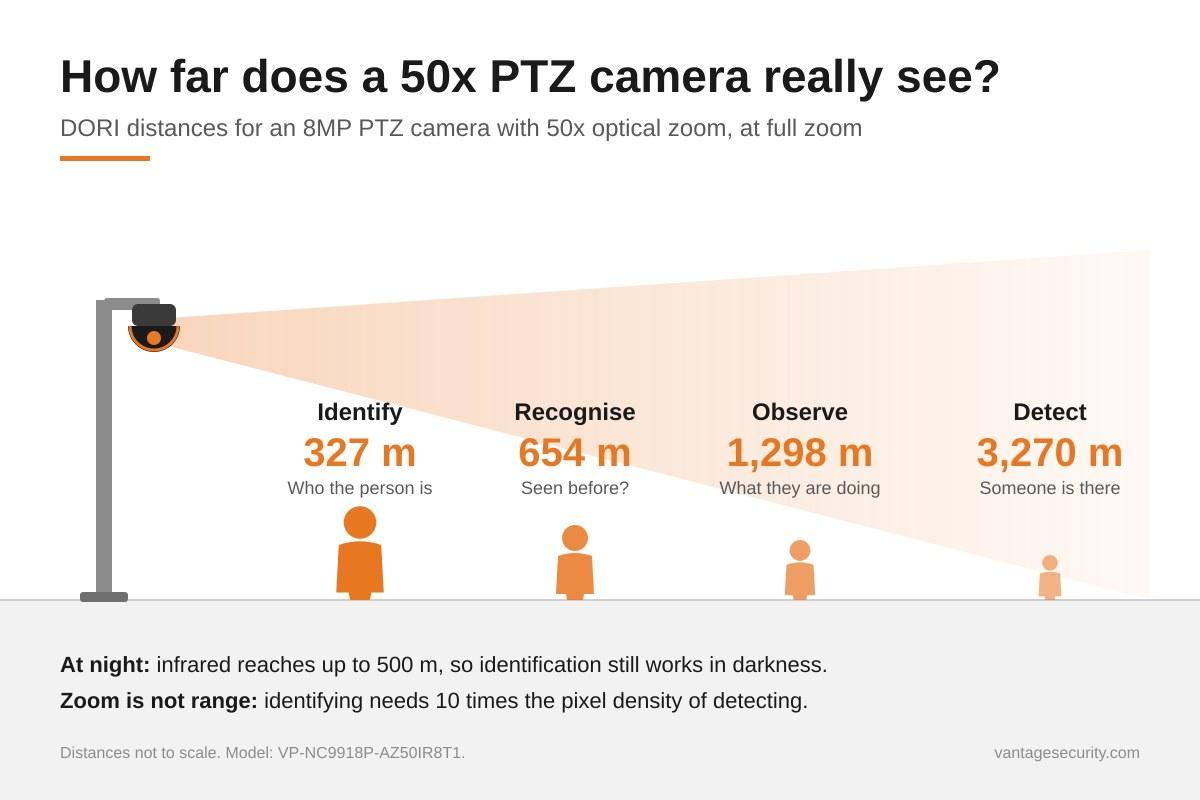
This guide explains what a PTZ camera is and how it works, when a PTZ camera is the right choice over fixed cameras, how far PTZ cameras really see by day and by night, what auto tracking does, when to add thermal imaging, what Gulf heat, dust and salt demand of the housing, and what a PTZ camera specification should include. Each section ends with the Vantage Security models that fit it.
What is a PTZ camera & how does it work?
A PTZ camera is a surveillance camera on a motorised head that can pan left and right, tilt up and down and zoom its lens in and out on command. One PTZ camera can sweep a wide area, then zoom in on a vehicle, a face or a number plate hundreds of metres away.
Every PTZ camera combines the same four things: a pan and tilt head that points it, an optical zoom lens that magnifies the scene, stored positions that let it move on its own, and a control link that lets an operator or software drive it. Let us look at each one.
Pan & tilt
Pan is the horizontal movement and tilt is the vertical movement. Full size PTZ cameras pan a full 360 degrees with no end stop, so they can keep turning in one direction, and tilt from just above the horizon to straight down. Auto flip lets the camera follow a person who walks directly underneath it without losing them. Compact mini PTZ cameras usually pan through a limited arc, such as 220 degrees, which suits a camera fixed to a wall rather than a pole.
Optical zoom
The zoom figure is the longest focal length of the lens divided by the shortest. A lens that runs from 5.3 mm to 265 mm is a 50x zoom. Optical zoom magnifies the scene with the lens itself, so the image keeps its full resolution. Digital zoom only enlarges pixels the sensor has already captured, so it adds size but not detail.
Presets, patrols & tours
A preset stores a pan, tilt and zoom position, such as a gate, a loading bay or a fence corner, and the camera can return to it in a moment. A patrol moves the camera through a list of presets in turn, and a tour replays a movement an operator has recorded. Full size PTZ cameras typically hold 300 or more presets. A camera on patrol still sees only one preset at a time.
Control
Operators drive PTZ cameras from a video management system or network video recorder, from a mobile app, or from a joystick keyboard in the control room. Network control uses ONVIF, and many PTZ cameras also keep an RS485 port with PELCO-P and PELCO-D protocols for older control systems.
Vantage Security PTZ joystick keyboards
- VV-JK1240IP-4AT1: enterprise network keyboard with a 4-axis joystick, LCD screen and RJ45 and serial connections.
See the full range of PTZ joystick controllers and PTZ cameras.
PTZ camera vs fixed camera: which do you need?
Use fixed cameras for areas that must be on record every second, and PTZ cameras for areas an operator or the camera's own analytics need to follow and zoom into. A PTZ camera records only where it points, so it works alongside fixed cameras rather than replacing them.
| Camera type | How it works | Best for | Vantage Security models |
|---|---|---|---|
| Fixed bullet or dome camera | One view, recorded all the time | Entrances, gates, corridors and cash points where every second must be on record | See the IP camera range |
| Mini PTZ camera | Compact head, 4x to 10x zoom, usually a 220 degree pan | Lobbies, car park levels and building corners | VP-NC8452P-Z04IR4B1 2MP 4x, VV-NC8452P-Z10IR5B1 2MP 10x, VP-NC8455P-Z10IR5B1 5MP 10x |
| Full size PTZ camera | 360 degree endless pan, 15x to 50x zoom, auto tracking | Yards, car parks, campuses, perimeters and roads | VP-NC9792P-AZ15IR6T1 2MP 15x, VP-NC9804P-AZ32IR7T1 4MP 32x, VP-NC9918P-AZ50IR8T1 8MP 50x |
| Bi-spectrum thermal PTZ camera | Thermal and visible cameras on one precision head | Coastlines, borders, ports and oil and gas perimeters, by day and night | VP-NC8884P-Z88THZ10I1, VP-NC8944P-AZ56THI1 |
When a PTZ camera is the right choice
- Large open areas: A yard, a car park or a perimeter fence is too big for fixed cameras to show useful detail without dozens of them.
- Live response: A guard needs to follow a person or vehicle and zoom in while an incident is happening.
- Long distances: The camera has to read a number plate or identify a face hundreds of metres away.
When fixed cameras are still the right choice
- Continuous evidence: Entrances, exits, gates and cash handling areas must be recorded every second, whichever way the PTZ camera is facing.
- Narrow views: A corridor or a doorway does not need a moving camera.
The rule is simple. If missing a second of footage in an area would matter, put a fixed camera on it. If the area is too large for fixed cameras to cover at a useful level of detail, add a PTZ camera on top.
How far can a PTZ camera see?
As far as its DORI distances say, not as far as its zoom number suggests. DORI, from the IEC EN 62676-4 standard, gives the distances at which a camera can detect, observe, recognise and identify a person, and a PTZ camera worth specifying should publish them.
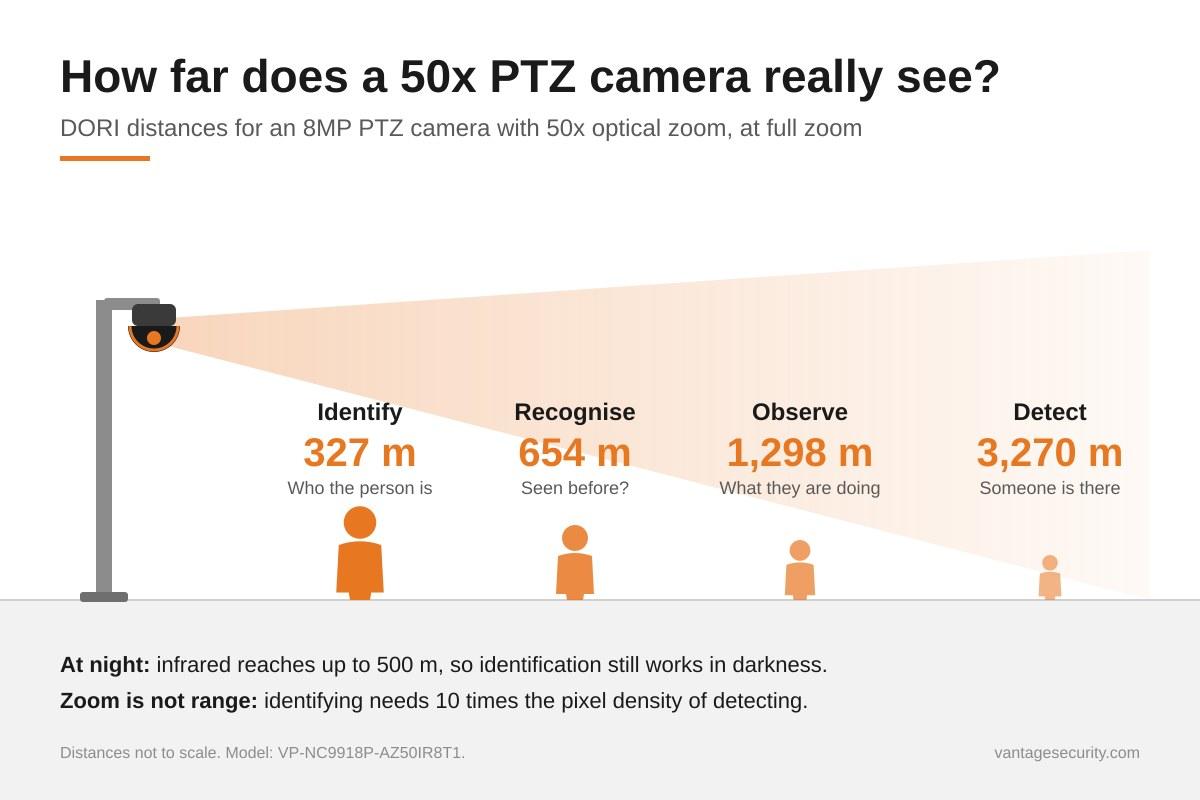
Each DORI level needs a set number of pixels for every metre of the scene. Detection needs 25, so you can tell that a person or vehicle is there. Identification needs 250, so you can tell who the person is beyond reasonable doubt. Because identification needs ten times the pixel density of detection, a camera identifies at one tenth of the distance at which it detects.
| DORI level | What you can see | Pixels per metre | VP-NC9918P-AZ50IR8T1, 8MP 50x, at full zoom |
|---|---|---|---|
| Detect | That a person is present | 25 | 3,270 m |
| Observe | Clothing and what the person is doing | 62 | 1,298 m |
| Recognise | Whether this is a person seen before | 125 | 654 m |
| Identify | Who the person is | 250 | 327 m |
Two things set the DORI distances: the focal length and the resolution. A longer lens puts more pixels on a distant target but narrows the view. A higher resolution sensor puts more pixels on the same view: an 8MP camera has 3,840 pixels across its image and a 2MP camera has 1,920, so at the same field of view the 8MP camera reaches each DORI level about twice as far away.
Decide which DORI level each area needs before you look at zoom figures. Identification suits entrances, checkpoints and plates you need to read. Recognition suits car parks and gates where you need to match a person to earlier footage. Observation and detection suit wide perimeters and open ground, where the job is to spot movement and send the camera or a guard to it.
Vantage Security long range PTZ cameras with published DORI
- VP-NC9918P-AZ50IR8T1: 8MP, 50x optical zoom, identifies a person at up to 327 m and detects at up to 3,270 m.
- VP-NC9778P-AZ37IR9T1: 8MP, 37x optical zoom, identifies a person at up to 296 m and detects at up to 2,960 m.
How far can a PTZ camera see at night?
Only as far as its infrared illuminator or the lighting on site reaches. If the IR range is shorter than the DORI distance you need, the extra zoom does nothing for you after dark.
Built-in infrared LEDs light the scene with light the camera can see and people cannot. Smart IR adjusts the beam as the lens zooms, so a distant target is lit without a close one turning white. The longest reach comes from laser illuminators, which keep a narrow beam over hundreds of metres. Starlight sensors add a third option: they keep a colour image in very low light, down to around 0.005 lux, so a lit car park or road stays in colour without infrared.
Compare the IR range with the DORI distances. The 50x model above identifies a person at 327 metres and its infrared reaches 500 metres, so it can identify at full distance in complete darkness. Its recognition distance of 654 metres is beyond the infrared, so at that range it needs street lighting or a thermal camera.
Vantage Security PTZ cameras for long range night vision
- VP-NC9778P-AZ37IR9T1: 8MP, 37x zoom, laser illuminator with continuous zoom reaching up to 800 m.
- VP-NC9918P-AZ50IR8T1: 8MP, 50x zoom, IR LEDs and laser illuminator reaching up to 500 m with zoom matching.
- VP-NC9774P-AZ50IR8T1: 4MP, 50x zoom, smart IR up to 500 m.
- VP-NC9812P-AZ40IR7T1: 2MP, 40x zoom, IR up to 400 m.
- VP-NC9804P-AZ32IR7T1: 4MP starlight, 32x zoom, colour down to 0.005 lux and IR up to 200 m.
Which zoom level does your site need?
Work back from the furthest point where you need to identify a person or read a plate, then choose a zoom and an IR range that reach it. A camera on a car park level needs far less zoom than one watching a port yard or a border fence.
| Zoom | Typical areas | IR range across the Vantage Security range | Vantage Security models |
|---|---|---|---|
| 4x to 10x | Lobbies, car park levels, building corners and small yards | 45 m to 100 m | VP-NC8455P-Z04IR4B1 5MP 4x, VV-NC8452P-Z10IR5B1 2MP 10x |
| 15x to 25x | Open car parks, campuses, warehouse yards and building perimeters | 150 m to 300 m | VP-NC9792P-AZ15IR6T1 2MP 15x, VP-NC9794P-AZ25IR6T1 4MP 25x, VP-NC9798P-AZ25IR6T1 8MP 25x |
| 32x to 40x | Logistics yards, stadium perimeters, highways and large car parks | 200 m to 400 m | VP-NC9812P-AZ32IR7T1 2MP 32x, VP-NC9812P-AZ40IR7T1 2MP 40x, VP-NC9818P-AZ32IR7T1 8MP 32x |
| 37x to 50x | Ports, airports, borders, coastlines and oil and gas perimeters | 500 m to 800 m, or thermal | VP-NC9778P-AZ37IR9T1 8MP 37x, VP-NC9918P-AZ50IR8T1 8MP 50x, VP-NC8884P-Z88THZ10I1 thermal |
More zoom is not always better. At full zoom the field of view is narrow, so a strong lens on a light pole picks up every sway and vibration, and a target crossing the view quickly is harder to follow by hand. Mount long zoom cameras on rigid poles or building structures, and look for image stabilisation on models that will spend their time at full zoom.
See the PTZ cameras by resolution: 2MP, 4MP, 5MP and 8MP.
What does auto tracking do on a PTZ camera?
Auto tracking lets the camera follow a person or vehicle on its own once its analytics detect one, panning, tilting and zooming to keep the target in frame. It turns a PTZ camera from one a guard has to drive into one that reacts by itself.
Tracking usually starts from a rule set on the camera: a line crossing, an intrusion into a zone, or a person or vehicle entering or leaving a region. The PTZ camera then locks on and follows the target until it leaves the view or the operator takes control.
Two limits are worth planning for. A tracking camera follows one target at a time, so a second intruder elsewhere goes unwatched by that camera. And while it tracks, it leaves its preset, which is why fixed cameras should still cover the areas that must always be recorded. Most PTZ cameras can be set to return to a home preset after a period with no movement.
Many PTZ cameras now carry more analytics than tracking alone. On the Vantage Security range these include face capture and comparison, unattended baggage and object removal detection, and number plate recognition on selected 8MP models. For dedicated plate reading at gates and car parks, see the guide to ANPR cameras.
Vantage Security PTZ cameras with auto tracking & analytics
- VP-NC9792P-AZ15IR6T1: 2MP, 15x zoom, auto tracking of people and vehicles and face recognition of up to 30 faces per second.
- VP-NC9804P-AZ32IR7T1: 4MP starlight, 32x zoom, auto tracking, intrusion and line crossing, and unattended baggage detection.
- VP-NC9918P-AZ50IR8T1: 8MP, 50x zoom, auto tracking, face capture and comparison, and optional ANPR.
- VP-NC9778P-AZ37IR9T1: 8MP, 37x zoom, auto tracking, face capture and comparison, and ANPR.
- VP-NC9784P-AZ4IR2T1: 4MP, 4x zoom, with a built-in microphone and speaker for two-way audio to warn intruders.
When should you choose a thermal or bi-spectrum PTZ camera?
Choose a bi-spectrum PTZ camera when you must detect people or vehicles in total darkness, smoke, haze or dust, or further away than infrared can reach. It pairs a thermal camera, which sees heat, with a visible camera that zooms in to show what the heat is.
A thermal camera does not need light. It sees the difference in temperature between a person or an engine and the ground behind them, so it picks out movement on an unlit coastline, across a desert perimeter or through smoke that would blind a visible camera. A thermal camera cannot identify a face or read a plate, which is why the visible camera on the same head matters: the thermal image raises the alarm and the visible camera zooms in to show what caused it.
Three things separate thermal PTZ cameras:
- Thermal resolution: 640 x 512 pixels is the common standard for long range perimeter work.
- Detector type: Uncooled VOx detectors need no cooling system and suit most perimeters. Cooled MCT detectors are more sensitive and suit the longest ranges, such as coastlines and borders.
- Thermal lens: A continuous zoom thermal lens, for example 35 mm to 350 mm, lets the thermal image zoom in step with the visible camera.
Precision matters as much as range. A head that holds its position to within 0.01 degrees keeps a target in frame at several kilometres, where a small movement of the camera is a large movement in the scene.
Vantage Security bi-spectrum thermal PTZ cameras
- VP-NC8884P-Z88THZ10I1: uncooled VOx 640 x 512 thermal with 35 mm to 350 mm zoom, 4MP visible camera with 88x zoom, 0.01 degree precision, IP67 and anti-corrosion coating for coastal sites.
- VP-NC8904P-AZ50THI1: cooled MCT 640 x 512 thermal with 30 mm to 660 mm zoom and 4MP visible camera with 50x zoom, for the longest ranges.
- VP-NC8944P-AZ56THI1: uncooled VOx 640 x 512 thermal and 4MP visible camera with 56x zoom, panning at up to 100 degrees per second.
- VP-NC8864P-Z50F75THI1: uncooled VOx 640 x 512 thermal with a choice of lenses and a 4MP visible camera.
See the full range of thermal cameras.
How do PTZ cameras cope with Gulf heat, dust, salt & hazardous areas?
Check four things: the upper operating temperature, the IP and IK ratings, corrosion protection on coastal sites and, in oil, gas and chemical plants, an explosion proof rating for the hazardous zone. A PTZ camera on a sun-exposed pole works hotter than the air temperature suggests, so leave a margin.
- Operating temperature: On the Vantage Security PTZ models that publish it, the upper limit runs from 55°C to 70°C. For cameras in direct summer sun, choose the higher end.
- IP rating: IP66 protects against powerful water jets and dust. IP67 adds protection against temporary immersion, which helps with wash-down, storms and blowing sand.
- IK rating: IK10 is the highest impact rating for enclosures and suits cameras within reach of vandals or vehicles.
- Heater & water removal: A built-in heater and fan clear frost, fog and condensation from the window, which matters on coastal sites where humid nights follow hot days.
- Lightning protection: Cameras on tall poles should carry surge protection on power and data. Larger models on the range carry 6,000 V TVS protection.
- Corrosion: Salt air attacks standard housings. Coastal and marine sites need an anti-corrosion coated or stainless steel PTZ camera.
- Hazardous areas: Refineries, fuel depots and offshore platforms need an explosion proof PTZ camera certified for the zone. The explosion proof CCTV camera guide explains zones, Ex markings and how to choose.
Vantage Security PTZ cameras for harsh & hazardous sites
- VP-NC9918P-AZ50IR8T1: IP67, IK10, -40°C to +70°C, 6,000 V TVS lightning protection, heater and fan with frost, fog and water removal.
- VP-NC6602P-Z25IR7VX1: anti-corrosion coated 2MP PTZ dome with 25x zoom, IR up to 200 m, IP67 and IK10.
- VP-NC8622P-Z33IR5S15: explosion proof 2MP PTZ camera with 33x zoom in 304 stainless steel (316 optional), for oil fields, chemical plants, ports and fuel stations.
See the full range of explosion proof cameras.
What power & network does a PTZ camera need?
Smaller PTZ cameras run on PoE+ (IEEE 802.3at), which supplies up to 30 W from each switch port. Large PTZ cameras with heaters and long range illuminators need PoE++ (IEEE 802.3bt), which supplies up to 60 W (Type 3) or 90 W (Type 4), or a separate power supply.
Check the PoE type on the datasheet before choosing the switch. A PoE+ switch cannot power a camera that needs 802.3bt, even though the port looks the same, and the switch's total PoE budget has to cover every camera running its heater at the same time. Compact mini PTZ cameras often run from a 12 V DC supply instead.
For recording, PTZ cameras stream to a network video recorder or video management system. H.265 and H.265+ compression keep the bandwidth and storage of 4K PTZ cameras manageable, and a micro SD card in the camera, up to 256 GB on the full size Vantage Security models, can hold footage if the network drops.
Vantage Security PTZ cameras by power requirement
- VP-NC9778P-AZ37IR9T1: high power PoE, IEEE 802.3bt at 90 W.
- VP-NC9918P-AZ50IR8T1: PoE, IEEE 802.3bt.
- VP-NC9804P-AZ32IR7T1: PoE++, IEEE 802.3bt.
- VP-NC9792P-AZ25IR6T1: PoE+, IEEE 802.3at.
- VP-NC8452P-Z04IR4B1: 12 V DC, 15 W maximum.
Vantage Security PTZ cameras compared
The Vantage Security PTZ range runs from compact 4x mini PTZ cameras for lobbies to 50x long range cameras and bi-spectrum thermal PTZ cameras for ports and perimeters.
| Model | Resolution | Optical zoom | Night vision | Protection | Power |
|---|---|---|---|---|---|
| VP-NC9918P-AZ50IR8T1 | 8MP (3840 x 2160) | 50x | IR and laser up to 500 m | IP67, IK10, -40°C to +70°C | PoE 802.3bt |
| VP-NC9778P-AZ37IR9T1 | 8MP (3840 x 2160) | 37x | Laser up to 800 m | IP67, IK10, -40°C to +70°C | PoE 802.3bt, 90 W |
| VP-NC9818P-AZ32IR7T1 | 8MP (3840 x 2160) | 32x | IR up to 200 m | IP67, IK10, -40°C to +65°C | PoE++ 802.3bt |
| VP-NC9798P-AZ25IR6T1 | 8MP (3840 x 2160) | 25x | IR up to 150 m | IP66, IK10, -40°C to +60°C | PoE+ 802.3at |
| VP-NC9774P-AZ50IR8T1 | 4MP (2560 x 1440) | 50x | Smart IR up to 500 m | IP67 | See datasheet |
| VP-NC9804P-AZ32IR7T1 | 4MP (2560 x 1440), starlight | 32x | IR up to 200 m | IP67, IK10, -50°C to +65°C | PoE++ 802.3bt |
| VP-NC9794P-AZ25IR6T1 | 4MP (2560 x 1440) | 25x | IR up to 150 m | IP66, IK10, -40°C to +60°C | PoE+ 802.3at |
| VP-NC9812P-AZ40IR7T1 | 2MP (1920 x 1080) | 40x | IR up to 400 m | IP67, IK10, -40°C to +65°C | PoE+ |
| VP-NC9812P-AZ32IR7T1 | 2MP (1920 x 1080) | 32x | IR up to 300 m | IP67, IK10, -40°C to +65°C | PoE+ 802.3at |
| VP-NC9802P-AZ32IR7T1 | 2MP (1920 x 1080), starlight | 32x | IR up to 200 m | IP67, -50°C to +65°C | PoE++ 802.3bt |
| VP-NC9792P-AZ15IR6T1 | 2MP (1920 x 1080) | 15x | IR up to 150 m | IP66, -30°C to +55°C | PoE+ 802.3at |
| VP-NC6602P-Z25IR7VX1 | 2MP (1920 x 1080), anti-corrosion | 25x | IR up to 200 m | IP67, IK10 | See datasheet |
| VV-NC8452P-Z10IR5B1 | 2MP (1920 x 1080), mini PTZ | 10x | IR up to 100 m | IP67 | 12 V DC |
| VP-NC8452P-Z04IR4B1 | 2MP (1920 x 1080), mini PTZ | 4x | IR up to 80 m | IP66 | 12 V DC |
See the complete range of PTZ cameras.
Where are PTZ cameras used?
PTZ cameras earn their place wherever an area is too large, or too far away, for fixed cameras to show useful detail: ports, airports, highways, city centres, oil and gas sites, stadiums and large car parks.
- Ports & logistics: Container yards and quays where a camera on a high mast follows vehicles and people across hundreds of metres.
- Roads & toll gates: Highways and junctions where operators zoom in on incidents and vehicles.
- Oil, gas & utilities: Plant perimeters and tank farms, often with thermal or explosion proof PTZ cameras.
- City surveillance: Squares, waterfronts and main streets watched from a central control room.
- Campuses & car parks: Hospitals, universities and malls where one PTZ camera covers an open car park.
Vantage Security has delivered surveillance projects on exactly these kinds of sites across the Middle East and Africa, including CCTV for all Salik gates in Dubai for the Roads & Transport Authority (RTA), over 6,000 IP cameras in Mecca, an IP CCTV surveillance system for ADNOC, complete CCTV for Maersk at Onne Port and Ademola Port in Nigeria, a thermal camera solution for International Airports DR Congo and a city surveillance project at Pattaya Koh Larn in Thailand.
What should a PTZ camera specification include?
Before you sign off a PTZ camera specification, confirm that each item below is written into it rather than assumed.
- DORI distances: Detect, observe, recognise and identify distances at full zoom, and the DORI level each area needs.
- Resolution & sensor: Resolution in pixels, sensor size and minimum illumination in colour and black and white.
- Optical zoom: The zoom ratio and the focal length range of the lens.
- Night vision: The IR or laser range, and whether it reaches the distance you need to identify at night.
- Movement: Pan range, tilt range, auto flip and the number of presets and patrols.
- Analytics: Auto tracking, line crossing and intrusion detection, face capture, and ANPR where plates must be read.
- Environment: Operating temperature range, IP and IK ratings, heater and water removal, lightning protection and corrosion protection.
- Hazardous areas: An explosion proof rating for the zone where the camera will be installed.
- Power: PoE type, IEEE 802.3at or 802.3bt, or the power supply, and the total PoE budget of the switch.
- Integration: ONVIF compliance, the recorder or video management system it must work with, and RS485 if older controllers are on site.
- Mounting: A rigid pole, wall or parapet mount that stays steady at full zoom.
Frequently asked questions
What is a PTZ camera?
A PTZ camera is a surveillance camera that can pan left and right, tilt up and down and zoom in and out by remote control. One PTZ camera can watch a wide area, then zoom in on a person, vehicle or number plate far away.
How far can a PTZ camera see?
How far a PTZ camera can see depends on the lens, the resolution and the lighting. Check the DORI distances: an 8MP PTZ camera with 50x optical zoom can detect a person at up to 3,270 metres but identify them at up to 327 metres. At night, the IR range also limits how far it can see.
What is the difference between a PTZ camera and a dome camera?
A fixed dome camera shows one view that does not change. Many PTZ cameras are also housed in a dome, often called a speed dome, but the camera inside can pan, tilt and zoom. The difference is the movement, not the shape.
Does a PTZ camera record everything around it?
No. A PTZ camera records only the view it is pointing at, even though it can turn through 360 degrees. Areas that must be recorded at all times, such as entrances and gates, need fixed cameras as well.
What is auto tracking on a PTZ camera?
Auto tracking lets the camera follow a person or vehicle on its own after its analytics detect them, for example when they cross a line or enter a zone. The camera pans, tilts and zooms to keep the target in frame until it leaves the view.
What is the difference between optical zoom and digital zoom?
Optical zoom magnifies the scene with the lens, so the image keeps its full resolution. Digital zoom enlarges pixels the sensor has already captured, so the image gets bigger but not more detailed. Compare PTZ cameras on optical zoom.
Does a PTZ camera need PoE++?
Small PTZ cameras run on PoE+ (IEEE 802.3at, up to 30 W per port). Large PTZ cameras with heaters and long range illuminators need PoE++ (IEEE 802.3bt, up to 60 W or 90 W per port) or a separate power supply. Check the datasheet before you choose the switch.
Can PTZ cameras work in Gulf heat?
Yes, if the operating temperature range covers it. Choose a camera rated to at least 60°C, and to 65°C or 70°C for poles in direct sun, with an IP66 or IP67 housing and a heater and fan to clear condensation.
Choosing the right PTZ camera
Start with the area, not the zoom figure. Decide which parts of the site must be recorded every second and cover them with fixed cameras. Then, for each area too large or too far away for that, decide whether you need to detect, recognise or identify, read the DORI distances, and check that the IR range or a thermal camera reaches the same distance at night. Finish with the housing, the power and the mounting. If you would like help matching a PTZ camera to your site, talk to the Vantage Security team.