Explosion Proof CCTV Cameras: What They Are, Where They Are Used and Top Options in the Middle East and Africa (MEA) Region
July 17, 2026
On an oil rig, inside a refinery or at a fuel storage terminal, the air itself can be dangerous. Flammable gases, vapours and dust mean that a single spark, even from a camera's own electronics, can ignite an explosion. That is why hazardous sites across the Gulf and larger MEA region cannot use standard CCTV. They need explosion proof cameras: certified, sealed units engineered so that nothing inside the housing can ever ignite the atmosphere outside it.
This guide explains what explosion proof actually means, how ATEX certification and hazardous area zones work, where these cameras are required across the region, and how to choose between fixed, zoom and PTZ models from the Vantage range.
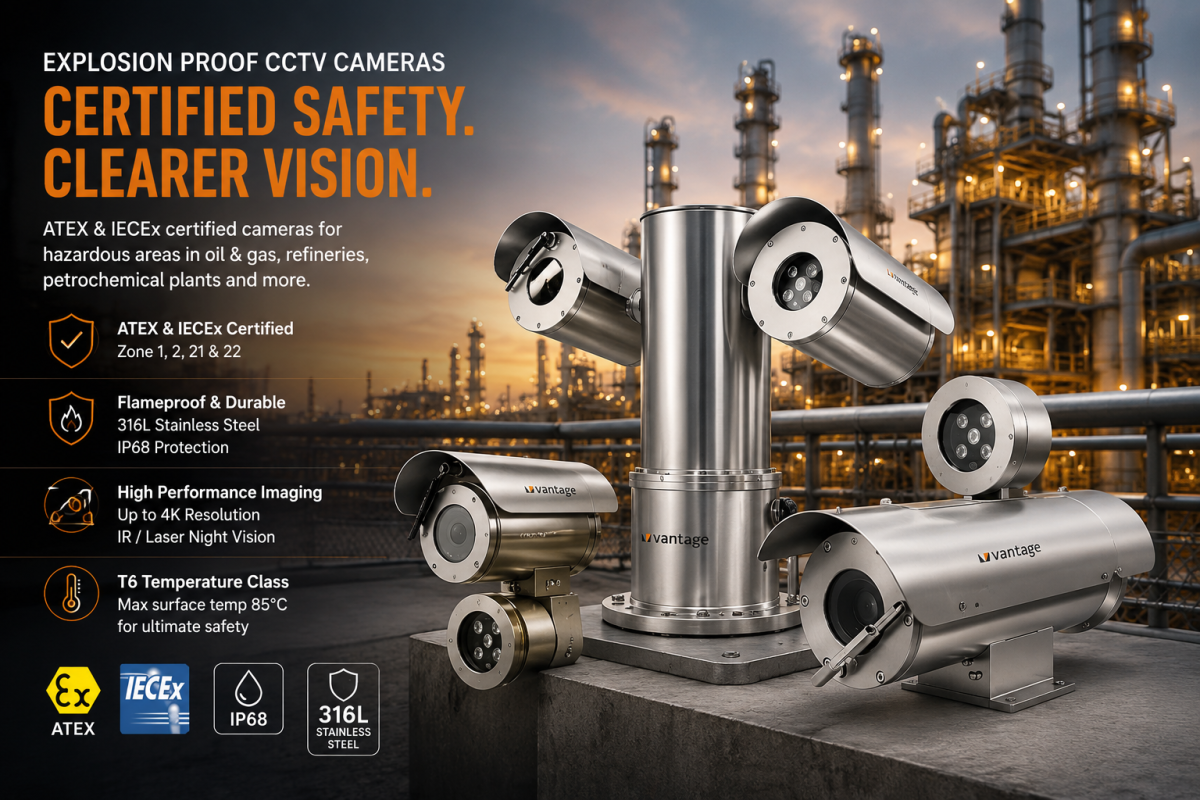
Table of contents
- What does explosion proof actually mean
- ATEX, zones and Ex markings explained
- Where explosion proof cameras are required in the Gulf
- Fixed, zoom or PTZ: choosing the form factor
- Vantage explosion proof cameras compared
- What to check before you buy
- Installation and maintenance in hazardous areas
- Why source your explosion proof CCTV from Vantage Security
- Frequently asked questions
- Get a quote for your hazardous area CCTV project
What does explosion proof actually mean
A common misconception is that an explosion proof camera is built to survive an external blast. In fact, the engineering works the other way around. An explosion proof (flameproof, or Ex d) enclosure is designed to contain any ignition that happens inside the camera itself, so that heat, sparks or flame can never escape into the surrounding atmosphere. The housing is machined from heavy stainless steel, the joints are flame paths that cool any escaping gas below ignition temperature, and the viewing window is toughened explosion-proof optical glass.
In practice this means three things for a buyer. The enclosure is milled from 304 or 316L grade stainless steel and sealed to IP68, so it also shrugs off dust, salt spray, washdowns and submersion. The glass is optics-grade, passing more than 96 percent of light so image quality does not suffer. And every unit carries a certification marking that states exactly which hazardous environments it is approved for, which is where ATEX comes in.
ATEX, zones and Ex markings explained
ATEX is the European directive for equipment used in explosive atmospheres, and it is the reference certification for hazardous-area CCTV across the Gulf. IECEx is the closely related international scheme; the technical requirements largely mirror each other. Sites are divided into zones based on how often an explosive atmosphere is present. Zone 0 means it is present continuously, Zone 1 means it is likely during normal operation, and Zone 2 means it occurs only occasionally and briefly. For dust rather than gas, the equivalent zones are 20, 21 and 22. Most hazardous-area camera positions in refineries, tank farms and process plants fall in Zone 1 or Zone 2.
Every certified camera carries an Ex marking that spells out its approval. Take the marking on the Vantage VV-NC91484B: II 2G Ex db IIC T6 Gb, II 2D Ex tb IIIC (85 degrees C) Db. Reading it left to right: Group II means surface industry rather than mining. Category 2G approves the unit for Zone 1 gas atmospheres, and 2D for Zone 21 dust. Ex db is the flameproof protection method. IIC is the most demanding gas group, covering hydrogen and acetylene, which automatically includes the IIA and IIB gases found in most oil and gas processing. T6 is the strictest temperature class, meaning the surface never exceeds 85 degrees C, safely below the ignition point of common hydrocarbons. If a datasheet does not show a marking like this, with a certificate number to back it, the camera is not truly explosion proof.
Where explosion proof cameras are required in the Gulf
The GCC concentrates some of the world's largest hazardous-area estates, and site HSE rules make certified equipment mandatory in classified zones. Typical deployments include:
- Oil and gas: drilling platforms, rigs, wellheads, gas processing plants and refineries, both onshore and offshore.
- Fuel storage and distribution: tank farms, loading terminals, jetties and petrol stations.
- Petrochemical and chemical plants: process areas, solvent stores and paint facilities.
- Marine and ports: steamships, LNG carriers, bunkering areas and port chemical handling.
- Heavy industry: steel plants, coal handling, mining, aviation fuelling and military facilities.
- Dust-risk sites: grain silos, flour mills and pharmaceutical production, where fine dust is itself explosive.
Beyond safety compliance, these cameras carry operational load: monitoring flare stacks, verifying lone workers, reading gauges with optical zoom, and feeding video analytics for intrusion and safety events, all in ambient temperatures that regularly exceed 50 degrees C in the Gulf summer. The Vantage units are rated for minus 30 to plus 70 degrees C, with humidity tolerance to 95 percent.
Fixed, zoom or PTZ: choosing the form factor
Explosion proof cameras come in three practical configurations, and the choice follows the monitoring task.
Fixed bullet
A fixed lens covering one defined view, such as a gate, pump skid or corridor. Compact, PoE-powered and the most economical certified option. The Vantage VV-NC91472B is the fixed workhorse of the range.
Zoom bullet
A motorised optical zoom inside the flameproof housing, letting operators pull in detail, gauge readings, valve positions, tag numbers, from a safe distance without entering the classified zone. The VV-NC91482B (2MP) and VV-NC91484B (4MP) both carry a 33x optical zoom with IR to 80 metres and optional laser illumination to 150 metres.
PTZ
Full pan-tilt-zoom on an explosion proof positioner, covering wide process areas, perimeters and flare lines with a single unit. The VP-NC8622P (2MP, 33x zoom) pans a full 360 degrees, tilts minus 90 to plus 90, holds 256 presets with auto cruise and tracking, and reaches 100 metres with IR.
Vantage explosion proof cameras compared
All four models share the same core engineering: ATEX-certified flameproof stainless steel enclosures, IP68 sealing, toughened explosion proof glass, an invisible nano wiper that repels water, oil and dust, and operation from minus 30 to plus 70 degrees C.
| Model | Type / resolution | Lens | Night vision | Enclosure | Best suited for |
|---|---|---|---|---|---|
| VV-NC91472B-AF3IR2EXT1 | Fixed bullet, 2MP (also available in 4, 6 and 8MP) | 3.6mm fixed (6mm, 8mm, 12mm options) | IR to 30 m | 304 SS (316 opt), IP68 | Gates, pump skids, single views |
| VV-NC91482B-AZ7IR4EXS15 | Zoom bullet, 2MP | 5.5-180mm, 33x optical zoom lens | IR to 80 m (laser 150 m opt) | 304 SS (316L opt), IP68 | Detail monitoring at distance |
| VV-NC91484B-AZ7IR4EXS15 | Zoom bullet, 4MP | 5.5-180mm, 33x optical zoom lens | IR to 80 m (laser 150 m opt) | 304 SS (316L opt), IP68 | High-detail process and perimeter |
| VP-NC8622P-Z33IR5S15 | PTZ, 2MP | 5.5-180mm, 33x optical zoom lens | IR range up to 100 m | 304 SS (316 opt), IP68 | Wide areas, flare lines, perimeters |
Specifications are indicative and subject to change. Request the latest datasheet for full details.
The 4MP VV-NC91484B adds a deep smart-analytics set on the edge: line crossing, area intrusion, loitering, crowd and rapid-movement detection, parking and object left/removed detection, scene change, audio detection and face detection, so the camera raises the alarm rather than the control room spotting it.
What to check before you buy
Six specifications decide whether an explosion proof camera is right for a given site:
- Zone certification: match the camera's category to your area classification. A Zone 1 (2G) approval covers Zone 2; the reverse is not true. Confirm the certificate number, not just the words 'explosion proof'.
- Gas group and temperature class: IIC and T6 are the most demanding ratings and cover the widest range of gases, including hydrogen. For dust sites, check the D marking and maximum surface temperature.
- Enclosure material: 304 stainless steel suits most plants; specify 316 or 316L for offshore, marine and high-chloride environments where corrosion resistance matters.
- Environmental rating: IP68 sealing, wide temperature range (minus 30 to plus 70 degrees C) and high humidity tolerance are essential in Gulf conditions.
- Optics and night vision: toughened explosion proof glass with high light transmission, IR or laser range matched to the distance you actually monitor, and optical zoom if operators need to read detail.
- Integration: ONVIF compatibility, H.265 compression, PoE or wide-voltage power, and analytics support so the cameras drop into your existing VMS.
Installation and maintenance in hazardous areas
Certification covers the camera; safe installation keeps it certified. Cable entries must use certified glands matched to the housing's threaded interfaces, and enclosures must never be opened while powered in a classified zone. Installation and maintenance should be carried out by technicians trained for hazardous-area work, with permits managed under the site's HSE system. It is also worth planning cleaning into the design: the nano wiper coating on the Vantage range sheds water, oil and dust, which extends the interval between manual lens cleans, a real cost saver when every visit to a classified zone needs a permit.
Why source your explosion proof CCTV from Vantage Security
Vantage Security is a UK-engineered, ISO 9001 and ISO 14001 certified supplier of surveillance and security systems across the GCC and wider MEA region. Our explosion proof range is ATEX certified with traceable certificate numbers, built in 304 and 316L stainless steel, and backed by UL, CE, FCC and RoHS approvals. The team supports hazardous-area projects end to end, from site survey and camera scheduling to supply, commissioning support and after-sales service for oil, gas and industrial clients across the UAE, Saudi Arabia, Qatar, Oman, Kuwait and Bahrain.
Frequently asked questions
What is the difference between ATEX and IECEx certification?
ATEX is the European Union directive for equipment in explosive atmospheres, while IECEx is the equivalent international certification scheme. The technical requirements are closely aligned, and Gulf operators commonly accept either. What matters is that the camera carries a genuine certificate number and an Ex marking that matches your site's zone classification.
What does the T6 temperature class mean?
T6 is the strictest temperature class in the Ex system. It guarantees the equipment's maximum surface temperature never exceeds 85 degrees C, keeping it safely below the auto-ignition temperature of virtually all industrial gases and vapours. A T6-rated camera can be used where gases with low ignition temperatures are present.
Are Zone ratings the same as Class 1 Division 1?
They are parallel systems. ATEX and IECEx use Zones (0, 1, 2 for gas), while the North American NEC system uses Classes and Divisions. Class 1 Division 1 broadly corresponds to Zones 0 and 1, and Class 1 Division 2 to Zone 2. Gulf projects specified to European standards will normally call for Zone-rated, ATEX or IECEx certified cameras.
Can a standard CCTV camera be used in a hazardous area with a protective housing?
No. Only equipment certified as a complete unit for the relevant zone may be installed in a classified area. Placing a standard camera inside a third-party enclosure does not create a certified product, and it would fail any HSE audit. The certification applies to the whole assembly, housing, glass, cable entries and electronics together.
How far can explosion proof cameras see at night?
The Vantage fixed model reaches 30 metres on built-in IR, the 33x zoom bullets reach 80 metres with IR and up to 150 metres with optional laser illumination, and the PTZ reaches 100 metres. True day/night operation with mechanical IR cut filters keeps images usable around the clock.
Get a quote for your hazardous area CCTV project
Tell us your site type, zone classification and the areas you need to monitor, and the Vantage team will recommend the right certified models and provide a tailored quote or a site survey anywhere in the Middle East and Africa (MEA) region.