AI Object Detection in X-Ray Baggage Scanners: How It Works and Which Models Have It
September 24, 2026
On an ordinary X-ray monitor, a knife carefully concealed inside a laptop sleeve may not appear clearly to the operator until someone traces the blade's outline. That is the job for every baggage scanner operator, repeated for every bag, for the length of a shift. AI object detection does not remove that job. It gives the operator a second set of eyes that never blink.
What AI object detection actually does
Vantage baggage scanners already split the X-ray image into up to seven colours by atomic number, separating organic and inorganic materials visually. That is material classification. It tells the operator what an object is probably made of. It does not tell the operator what the object actually is.
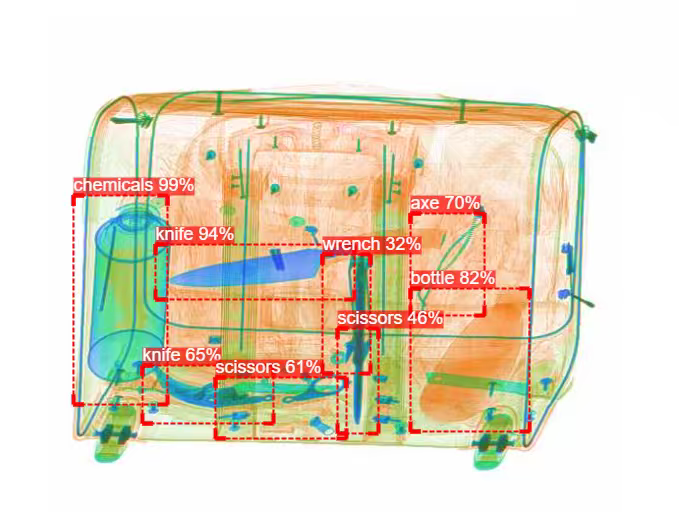
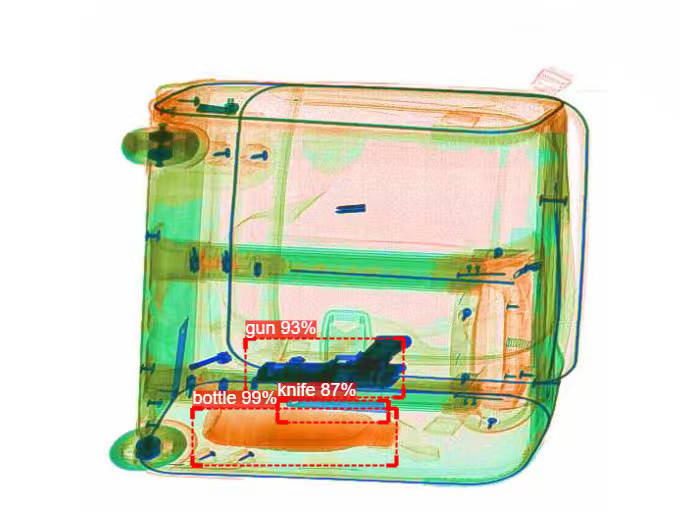
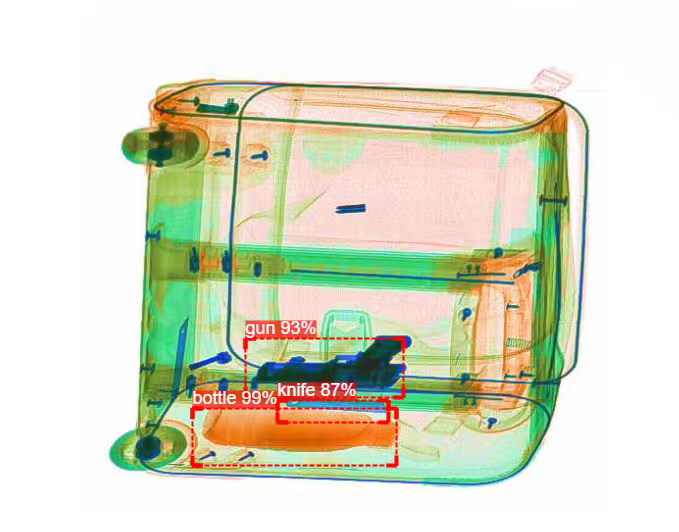
AI object detection adds a second layer on top of that. It scans the live image in real time and draws a box around specific object shapes as they cross the tunnel, labelling items such as handguns, knives and scissors the moment they are recognised, instead of leaving the whole interpretation to the operator's eye. In demo footage of the feature, it labelled a handgun, a knife, a pair of scissors and a firecracker individually as each one passed through the tunnel.
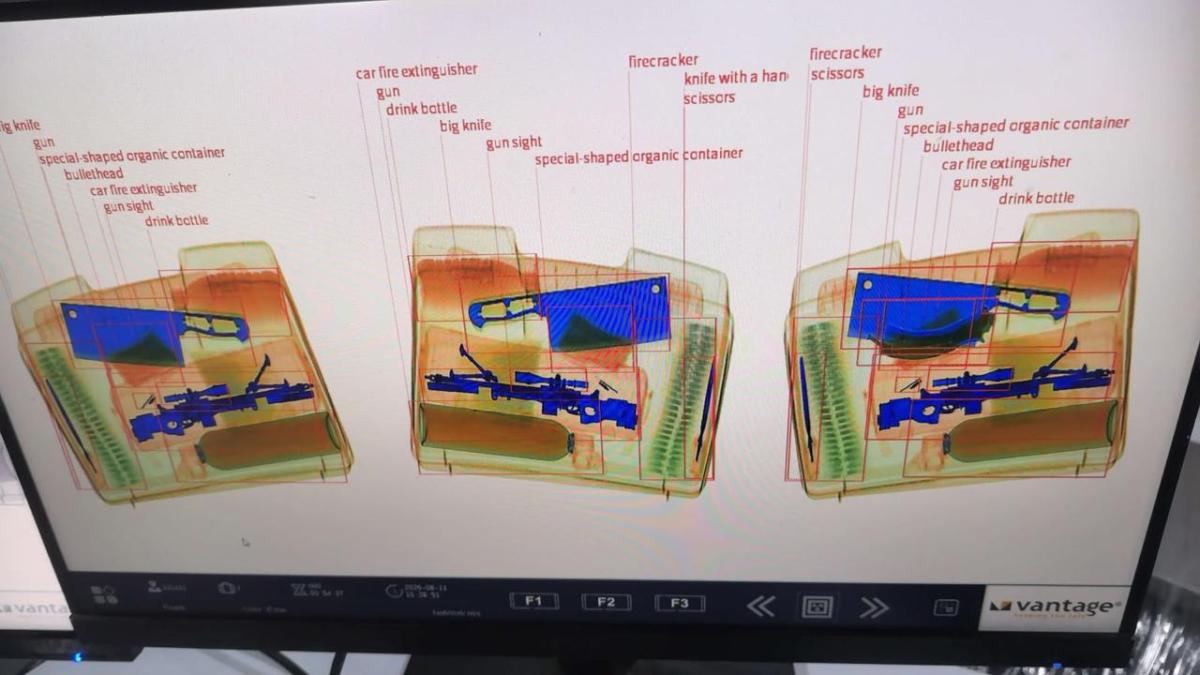
Vantage's product specifications describe the feature as trained to recognise more than 150 object categories, listed on several models as “AI object identification with 150+ objects detection.”
What this looks like on screen
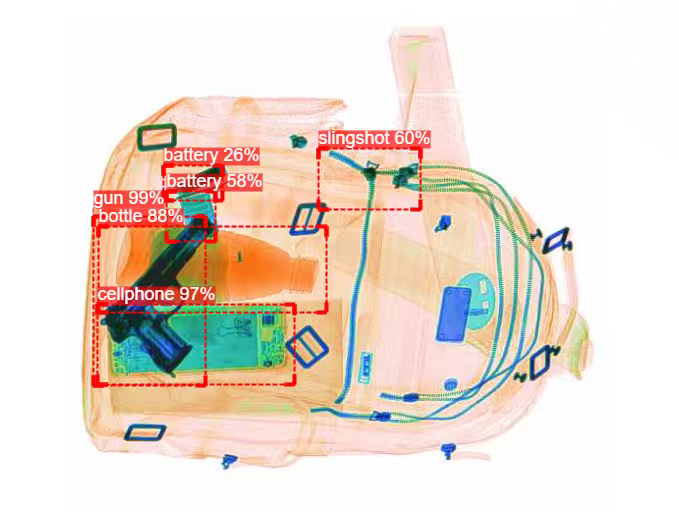
Which Vantage baggage scanners have AI Object Detection Capabilities
AI object detection is available as optional on all models running Windows OS. Some models also offer Advanced AI features. The table below shows the current range.
| Model Number | Tunnel Size | Single or Dual Generator & Dual View | AI Object Detection |
| VP-XR3500-BSJ8 | 50 x 30 cm | Single Generator | Advanced AI Available: Optional |
| VP-XR6550S-BSJ8 | 65 x 50 cm | Single Generator | Advanced AI Available: Optional |
| VP-XR7550S-BSJ8 | 75 x 55 cm | Single Generator | Advanced AI Available: Optional |
| VP-XR1010S-BSJ8 | 100 x 100 cm | Single Generator | Advanced AI Available: Optional |
| VP-XR1010S-NCBSJ8 | 100 x 100 cm | Single Generator | Advanced AI Available: Optional |
| VP-XR6550S-NCBSDJ8 | 65 x 50 cm | Single Generator | Advanced AI Available: Optional |
| VP-XR1080S-BSS16 | 100 x 80 cm | Single Generator | Basic AI Detection: Standard Advanced AI Available: Optional |
| VP-XR60403D-BSJ8 | 60 x 40 cm | Single Generator, 3D view | Advanced AI Available: Optional |
| VP-XR65503D-BSJ8 | 66 x 50 cm | Single Generator, 3D view | Advanced AI Available: Optional |
| VP-XR6040D-BSJ8 | 60 x 40 cm | Dual Generator and Dual View | Advanced AI Available: Optional |
| VP-XR1000D-BSJ8 | 100 x 100 cm | Dual Generator and Dual View | Advanced AI Available: Optional |
| VP-XR6040W-BSS16 | 60 x 40 cm | Single Generator | Basic AI Detection: Standard Advanced AI Available: Optional |
| VP-XR6550D-BSS16 | 65 x 50 cm | Dual Generator and Dual View | Basic AI Detection: Standard Advanced AI Available: Optional |
| VP-XR1010D-BSS16 | 100 x 100 cm | Dual Generator and Dual View | Basic AI Detection: Standard Advanced AI Available: Optional |
Single view or 3D view or Dual View (With Dual Generators giving Horizontal and Vertical views): which tunnel to specify
Single-view models scan from one angle. That is enough detail for a checkpoint with a steady, moderate flow, where bags are mostly packed the way people usually pack them: spread out, not stacked.
3D dual-view models give an isometric 3D view of the object with a single x-ray source/generator.
Dual-view scanners add a second, independent view (horizontal and vertical) of the scanned item. An object hidden behind something denser in one angle often shows up in the other. Paired with AI object detection, both views get their own recognition pass, which matters most where bags are packed densely or a checkpoint cannot afford a second look.
Neither is the universal answer. A single-view scanner with AI object detection suits a well-run checkpoint with predictable baggage. A dual-view or 3D dual-view scanner earns its larger footprint and higher cost at a checkpoint where queue volume or risk profile leaves no room for a missed angle.
What AI object detection does not replace
It does not replace the material classification described above. Explosives and narcotics detection on the Vantage range still runs on the Zeff-scan function, which highlights the atomic number range associated with explosives and narcotics (Zeff 7, 8 and 9) directly on the coloured image. AI object detection flags recognisable shapes. Zeff-scan flags material composition. The two work together, not as substitutes for each other.
It does not replace Threat Image Projection either. TIP inserts a realistic but fictional threat image into a real bag as it passes through the scanner, to keep an operator's attention sharp and test image-reading skill. AI object detection works the other way round: it runs on real bags, in real time. One trains the operator. The other assists the operator. AI object detection is a standard feature on these models; Threat Image Projection remains a separate, optional extra.
And it does not take the decision away from the operator. The system boxes and labels the object. Whether to raise the alarm, recheck the bag or escalate it stays with a trained screener.
Specifying it into a project
Besides standard AI object detection, the two things worth confirming before a quote goes out are that the tunnel size matches the baggage profile at the checkpoint, and whether the Advanced AI tier is wanted on VP-XR1010D-BSS16, VP-XR6040W-BSS16 or VP-XR6550D-BSS16, since that remains a separate line item. Operator training should still cover the labelled-object workflow alongside Threat Image Projection where both are specified together.
Vantage has delivered baggage-screening projects at checkpoints across the MEA region and globally, including the US Air Force Base Al Dhafra in the UAE, the Qatar Embassy, Bangkok Port, the British Council, the National Intelligence Agency of Bahrain, Onne Port and Ademola Port in Nigeria, and a more recent screening upgrade for the UN Development Programme (UNDP) pairing 3D X-ray baggage screening with 33-zone walk-through metal detection. For the wider set of criteria that go into choosing an X-ray scanner, including compliance, total cost of ownership and delivery timelines, see Vantage's guide to choosing an X-ray scanner for customs inspection.
A second AI-based feature: AI Roller
Many of the AI-capable models above also list a separate feature called AI Roller, an intelligent system that automates the conveyor to start automatically when an object is detected, also optional: VP-XR3500-BSJ8, VP-XR6550S-BSJ8, VP-XR7550S-BSJ8, VP-XR60403D-BSJ8, VP-XR65503D-BSJ8, VP-XR1010S-NCBSJ8, VP-XR1010S-BSJ8 and VP-XR6040D-BSJ8.
Frequently asked questions
Does AI object detection replace the human operator?
No. It labels recognised object shapes as bags move through the tunnel. The alarm response and the decision to recheck a bag stay with the operator.
What is the difference between AI object detection and Threat Image Projection (TIP)?
AI object detection runs on real bags during live screening, recognising object shapes such as knives and firearms, and is a standard feature on Windows OS models. TIP inserts a fictional threat image into a real bag image as a training and attentiveness check and remains a separate, optional extra on the same models.
Which Vantage X-ray baggage scanners currently offer AI object detection?
Basic AI detection comes as a standard feature on many of the Vantage X-ray baggage scanners running Windows OS: VP-XR1080S-BSS16, VP-XR6040W-BSS16, VP-XR6550D-BSS16, VP-XR1010D-BSS16 and many others. Models that run embedded Linux, such as VP-XR8650-BSS16, VP-XR6040-BSS16, VP-XR6550-BSS16 and VP-XR1000-S16, do not offer AI features. For Advanced AI features, it is an optional extra on all Windows based models.
What is the difference between AI object detection and advanced AI object detection?
AI object detection is the standard feature across many Windows OS models in the range. Advanced AI object detection is a further tier available as an optional extra.
What is AI Roller, and is it the same as AI object detection?
No. AI Roller is a separate optional feature. It automatically detects objects placed on the conveyor belt through the help of sensors to automate the process and avoid unnecessary wear, thus saving energy and extending the life of the conveyor.
Does AI object detection replace dual-energy material classification?
No. Material classification, the four and seven colour imaging plus Zeff-scan, shows what an object is likely made of. AI object detection shows what shape the object is. Both run on the same scanner and answer different parts of the same screening question.
Is AI object detection a standard feature or an optional add-on?
It is a standard feature on many of the Windows OS models in the range. Some models additionally offer Advanced AI object detection as a further optional extra.