Road Blockers: How They Work, Crash Ratings & How to Specify One
November 12, 2026
Key Takeaways
- A road blocker is a steel wedge that rises from a pit to close the full width of a vehicle lane, then lowers flush with the road so authorised traffic can drive over it.
- A crash rating records the truck, the speed and how far the truck got past the barrier. Speed matters most: a 7.5 tonne truck at 80 km/h carries almost three times the energy it carries at 48 km/h.
- Choose the rating from the speed a vehicle can actually reach on the approach, then ask for zero penetration where people or buildings sit close behind the lane.
- A shallow mount road blocker needs far less excavation, which matters where cables, pipes or a basement run under the entrance.
- Decide what the road blocker must do in a power cut and in an emergency before choosing one. Backup systems and emergency closing speeds differ from one road blocker to the next.
A road blocker is the barrier you see at embassy gates, ministry entrances, data centres and port checkpoints: a heavy steel plate that sits flush with the road until it is needed, then rises in a few seconds to close the whole lane. A boom barrier only tells a driver to stop. A crash rated road blocker is built and tested to stop a truck whose driver does not.
This guide explains how road blockers work, what crash ratings such as K4, K12, M50 and PAS 68 actually measure, how deep the foundation needs to be, what happens when the power fails and what a good specification should include. Each section ends with the Vantage Security models that fit it. Choosing between road blockers, bollards, tyre killers and rapid deployment barriers for a whole site is covered in our guide to choosing bollards and road blockers for hostile vehicle mitigation.
What is a road blocker & how does it work?
A road blocker is a steel barrier set into a pit across a vehicle lane. When it is raised, its front edge forms a wedge that a vehicle cannot drive over. When it is lowered, the top plate sits level with the road and traffic passes over it as if it were part of the surface.
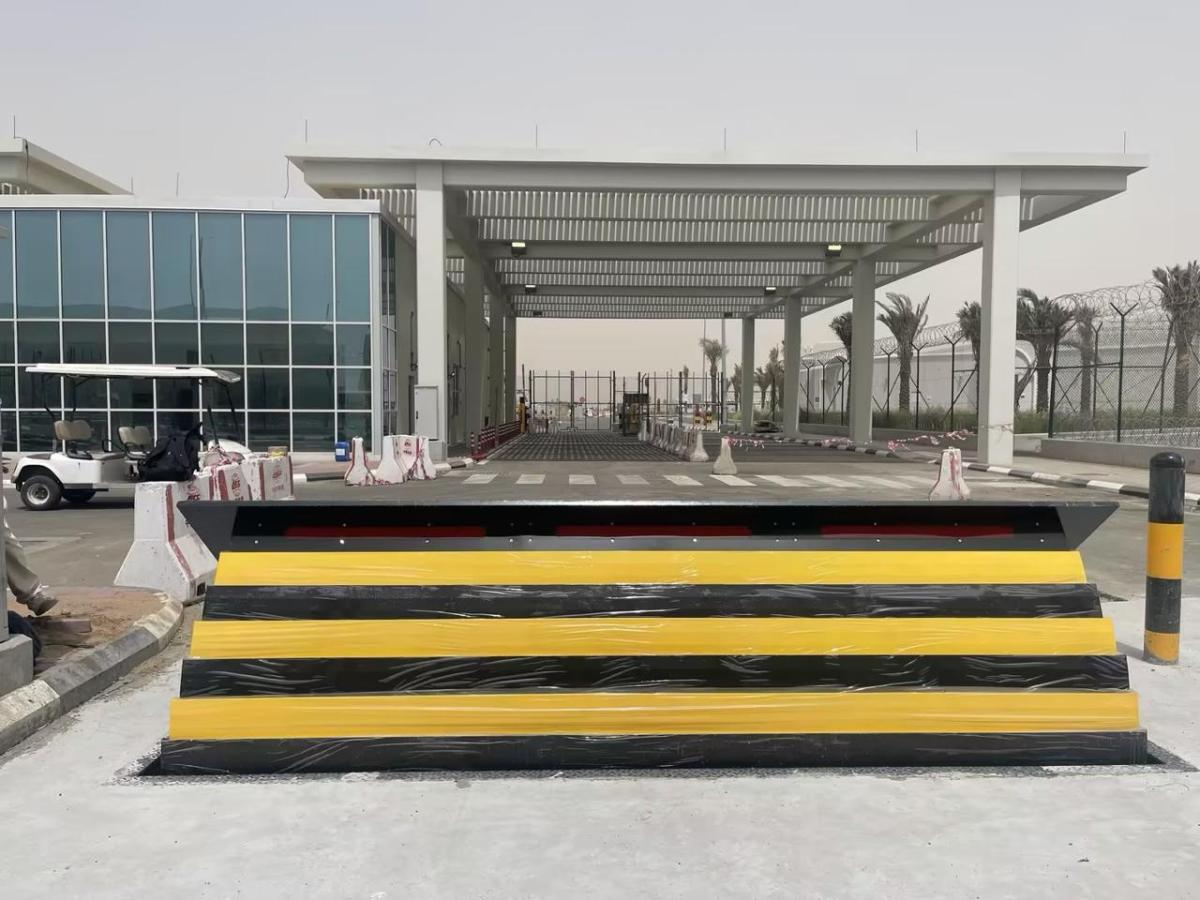
A newly installed Vantage Security road blocker in the raised position, closing a vehicle lane at a high security entrance.
Every road blocker is built from the same four parts: the blocking plate that stops the vehicle, the pit and frame that hold it in the ground, the hydraulic drive that moves it, and the control system that decides when it moves. Let us discuss each part of a road blocker in detail.
The blocking plate
The blocking plate is the part a vehicle actually hits. It is a thick steel top plate, usually with an anti-skid surface so tyres keep their grip when it is lowered, backed by a steel structure that takes the force of an impact. Two figures describe it. The raised height, often called the intercept height, is how far the front edge rises above the road, typically between 650 mm and 1,000 mm. A higher plate meets a truck bumper and chassis more squarely. The width is the lane width the plate closes, and a single unit is normally made to close a full traffic lane of 3 to 6 metres, so there are no gaps for a vehicle to aim at.
The pit & frame
The blocking plate sits in a steel frame cast into a concrete pit under the road. The frame carries the impact load down into the foundation, which is why a crash rating only holds when the pit is built to the drawing used in the crash test. Pits come in two depths: shallow mount pits of a few hundred millimetres, and deep mount pits of around a metre or more. The pit also needs drainage, because rainwater and sand collect in it. Pit depth is covered in more detail further down.
The hydraulic drive
An electric motor drives a hydraulic pump, and the oil pressure moves one or two hydraulic cylinders under the plate to lift it and lower it. The pump, oil tank and valves form the hydraulic power unit, which often sits in a cabinet beside the lane and connects to the cylinders through oil pipes. In normal use a road blocker rises in 3 to 5 seconds. Many road blockers also offer emergency fast operation (EFO), which raises the plate in about 1.5 to 2 seconds when a guard needs to close the lane at once.
The control system
A controller, usually a PLC, runs the raise and lower sequence. It takes commands from a keypad or push buttons at the guard post, a wireless remote, the access control system and the inductive loop detectors buried in the road. The loops tell the controller when a vehicle is over the plate, so it never rises under a car, and traffic lights tell drivers when they can move.
Vantage Security road blockers
- VV-VM7501-RBZ4: crash rated shallow mount road blocker that rises 1,000 mm from a 300 mm deep pit, for lanes of 3, 4 or 5 metres.
- VV-VM7000-RBZ4: deep mount road blocker that rises 650 mm, for lanes of 3 to 6 metres and intensive daily use.
See the full range of road blockers.
Road blocker vs bollard vs tyre killer: what is the difference?
All of them control vehicles at an entrance, but only crash tested road blockers and bollards are designed to stop a vehicle that is driven at them on purpose.
| Barrier | How it works | Best for | Vantage Security models |
|---|---|---|---|
| Road blocker | A steel wedge rises across the full width of the lane | Single vehicle lanes at high security gates, checkpoints and service entrances | VV-VM7501-RBZ4 shallow mount, VV-VM7000-RBZ4 deep mount |
| Hydraulic bollards | Steel posts rise from the ground in a line, with gaps people can walk through | Entrances that must stay open to pedestrians, and wide or curved frontages | VV-VM5002HD-BLZ4 and VV-VM7329HD-BLZ4 tested at 80 km/h, VV-VM3001HD-BLZ4 tested at 48 km/h |
| Fixed bollards | Permanent crash tested posts with no moving parts | Perimeter lines and building frontages that vehicles never need to cross | VV-VM7301FD-BLZ4, VV-VM7329FD-BLZ4 and VV-VM7410FD-BLZ4, all tested at 48 km/h |
| Light duty bollards | Smaller hydraulic or fixed posts, tested with a car rather than a truck, or not crash tested | Car parks, residential and commercial entrances that need to control cars, not stop a hostile truck | VV-VM7115HD-BLZ4 and VV-VM2100HD-BLZ3 hydraulic, VV-VM7115FD-BLZ4 fixed, VV-VM4104FD-BLFZ4 surface mount |
| Tyre killers | Steel spikes rise to puncture the tyres of a vehicle driving the wrong way | One-way control at car park and site exits, not stopping a hostile vehicle | VV-VM7100-TKZ4 hydraulic, VV-VM7100F-TKZ4 flush mount, VV-VM7106S-TKZ4 spring driven with no external power |
| Rapid deployment anti-ram barrier | Free-standing steel units placed by hand, with no ground anchoring | Events, temporary road closures and sites where the road cannot be dug up | VV-VM1000-ARJ8 placed without tools |
What do crash ratings like K4, K12, M50 & PAS 68 mean?
A crash rating records a real test. A truck of a set weight is driven into the barrier at a set speed, and the testers measure how far the truck or its load got past the barrier line. Three families of ratings are in common use, and project specifications in the Gulf usually ask for one of them by name.
ASTM M ratings & K ratings
The US ASTM F2656 standard tests with a 6,800 kg medium duty truck. M30, M40 and M50 mean impact speeds of 48, 64 and 80 km/h. A penetration rating follows: P1 means the truck travelled no more than 1 metre past the barrier, P2 up to 7 metres, P3 up to 30 metres and P4 more than 30 metres. K4, K8 and K12 are the older US Department of State ratings for the same truck at 30, 40 and 50 mph, which are 48, 64 and 80 km/h, and they are still widely quoted.
PAS 68 & IWA 14-1 classifications
PAS 68, from the British Standards Institution, and IWA 14-1, the international equivalent, record the result as a short code rather than a single grade. Take PAS68:2013 V/7500(N3)/80/90:0.0 as an example. Read from left to right, it means a vehicle security barrier, a 7,500 kg truck in vehicle class N3, an impact speed of 80 km/h, a head-on impact at 90 degrees and 0.0 metres of penetration: the truck did not get past the barrier. An IWA 14-1 code such as V/7200(N3C)/80/90:0.0 reads the same way.
| Rating | Test vehicle | Impact speed | Penetration recorded as |
|---|---|---|---|
| K4 / M30 | 6,800 kg truck | 48 km/h (30 mph) | P1 to P4 on M ratings |
| K8 / M40 | 6,800 kg truck | 64 km/h (40 mph) | P1 to P4 on M ratings |
| K12 / M50 | 6,800 kg truck | 80 km/h (50 mph) | P1 to P4 on M ratings |
| PAS 68 | Stated in the code, for example 7,500 kg N3 | Stated in the code, for example 48 or 80 km/h | Metres, for example 0.0 |
| IWA 14-1 | Stated in the code, for example 7,200 kg N3C | Stated in the code, for example 48 or 80 km/h | Metres, for example 0.0 |
Why speed matters more than weight
The energy a barrier has to absorb rises with the square of the speed. A 7,500 kg truck at 48 km/h carries about 667 kJ. The same truck at 80 km/h carries about 1,852 kJ, nearly three times as much. That is why the speed in a rating matters more than any other figure, and why an 80 km/h road blocker is a different product from a 48 km/h one, not just a thicker version of it.
Vantage Security road blocker crash tests
- VV-VM7501-RBZ4: PAS68:2013 V/7500(N3)/80/90:0.0 and IWA14-1:2013 V/7200(N3C)/80/90:0.0, the 80 km/h class of K12/M50.
- VV-VM7000-RBZ4: impact tested with a 6,800 kg vehicle at 65 km/h, equivalent to K8/M40.
Which crash rating does your site need?
Start with the fastest speed a vehicle could reach on the way to the barrier, not with the type of building. A long straight approach lets a truck accelerate towards 80 km/h. A short run-up, a sharp bend or a chicane keeps it far slower, and a 48 km/h rating may then be enough.
- Measure the run-up: The longest straight line a vehicle could drive towards the lane, including across kerbs, verges and open plazas.
- Plan for 80 km/h on straight approaches: A straight public road leading to the gate calls for a barrier rated at 80 km/h.
- Use the layout to lower the speed: Bends, chicanes, planters and speed tables before the gate can justify a 48 or 64 km/h rating.
- Check what is behind the barrier: If a building, a lobby or a queue sits close behind the lane, ask for zero penetration or P1.
- Match the rating along the whole line: An 80 km/h road blocker protects nothing if the bollards beside it are rated for 48 km/h and a driver can choose either.
On high risk sites, the threat level and the approach speed should be set by a security consultant or a vehicle dynamics assessment. Our hostile vehicle mitigation guide sets out typical barrier choices for low, medium and high threat sites.
Vantage Security barriers for 80 km/h approaches
- VV-VM7501-RBZ4: road blocker for vehicle lanes, tested at 80 km/h with zero penetration.
- VV-VM5002HD-BLZ4: hydraulic bollard for the frontage beside the lane, tested with a 7,500 kg truck at 80 km/h.
- VV-VM7329HD-BLZ4: hydraulic bollard, 900 mm high, PAS 68 tested with a 7,500 kg truck at 80 km/h.
Shallow mount or deep mount road blocker?
The depth of the pit decides how much digging the entrance needs, and that is often what decides the road blocker. Entrances in the Gulf commonly carry power cables, chilled water lines, irrigation pipes and telecom ducts under the road, and some sit on a basement slab or a bridge deck where a deep pit is not possible.
- Shallow mount: The pit is only a few hundred millimetres deep, so excavation is quicker and most buried services can stay where they are. This is the choice for basements, bridge decks and busy existing entrances.
- Deep mount: The pit is around a metre deep or more. It needs more civil works, but suits new entrances where the ground is clear.
Whichever depth you choose, plan the drainage at design stage, because a road blocker pit collects rainwater and sand, and a drainage pump may be needed to clear it. Ask for the foundation and reinforcement drawing that matches the crash test, because a crash rating only holds when the unit is installed the way it was tested.
Vantage Security shallow & deep mount road blockers
- VV-VM7501-RBZ4: shallow mount, with an underground depth of only 300 mm.
- VV-VM7000-RBZ4: deep mount, 880 mm deep, with an optional drainage pump for the pit.
What happens in a power cut or an emergency?
A road blocker has to keep working when the mains supply fails, and it has to close fast when something goes wrong. Check three things.
Power failure
There are three common backups. A hydraulic accumulator stores oil under pressure so the plate can still be raised or lowered when the power is off. A storage battery or a UPS keeps the controls and the pump running for a period. A manual hand pump lets a guard move the plate by hand as a last resort. Decide which of these you need, and which position the plate should take when the power is lost.
Emergency fast operation
EFO raises the plate in about 1.5 to 2 seconds instead of the normal 3 to 5 seconds, for the moment a hostile vehicle is approaching. Emergency buttons at the guard post can trigger it, and some road blockers add a lockdown function to the emergency buttons.
Safety for everyday traffic
Day to day, the risk is an authorised vehicle being caught by a rising plate. Inductive loop detectors stop the plate rising while a vehicle is over it. Red and green traffic lights tell drivers when to move, and LED warning lights and reflective strips make the raised plate easy to see at night.
Vantage Security backup & emergency options
- VV-VM7501-RBZ4: hydraulic accumulator for power cuts, storage battery and manual pump available, EFO in 2 seconds or less.
- VV-VM7000-RBZ4: manual hand pump, optional accumulator and UPS, EFO in about 1.5 seconds and emergency buttons with lockdown.
How do road blockers connect to access control, ANPR & security systems?
A road blocker is normally lowered by the same system that admits the vehicle. Authorised vehicles can lower it automatically with RFID tags or ANPR number plate recognition, traffic lights show drivers when they can pass, and a fire alarm signal can lower the barriers for an emergency evacuation.
- Access control & intercom: The road blocker controller connects to the access control system and to an intercom at the gate, and status indicators show the guard whether the plate is raised or lowered.
- Interlocking: For higher threat sites, two barriers can be interlocked as an air-lock, so the second only opens once the first has closed behind the vehicle. The vehicle can be held between them for an under vehicle surveillance check.
- Central control: Vantage Security supports remote management and central monitoring of road blockers and hydraulic bollards from a security control room.
Vantage Security integration options
- VV-VM7501-RBZ4: PLC control with keypad and wireless remote, 2-channel loop detector and optional traffic lights.
- VV-VM7000-RBZ4: interfaces for access control and intercom, air-lock interlocking, inductive loops and status indication.
Vantage Security road blockers compared
The two Vantage Security road blockers cover different sites: one for high speed approaches and shallow ground, the other where a deeper pit is possible and the approach speed is lower.
| Model | Crash test | Raised height | Pit depth | Lane width | Power failure & EFO |
|---|---|---|---|---|---|
| VV-VM7501-RBZ4 | PAS68:2013 V/7500(N3)/80/90:0.0 and IWA14-1:2013 V/7200(N3C)/80/90:0.0, the 80 km/h class of K12/M50 | 1,000 mm | 300 mm | 3,000, 4,000 or 5,000 mm | Hydraulic accumulator, battery and manual pump; EFO in 2 s or less; IP68 |
| VV-VM7000-RBZ4 | 6,800 kg vehicle at 65 km/h, equivalent to K8/M40 | 650 mm | 880 mm | 3,000 to 6,000 mm | Manual hand pump, optional accumulator and UPS; EFO in about 1.5 s; IP67 |
Other crash tested barriers in the Vantage Security range are often used alongside road blockers on the same perimeter:
| Model | Type | Crash test | Height | Depth |
|---|---|---|---|---|
| VV-VM5002HD-BLZ4 | Hydraulic bollard | PAS 68 and IWA 14-1 with a 7,500 kg truck at 80 km/h, the K12/M50 class | 1,000 mm | 1,556 mm |
| VV-VM7329HD-BLZ4 | Hydraulic bollard | PAS68:2013 with a 7,500 kg N3 truck at 80 km/h, head-on at 90 degrees | 900 mm | 1,300 mm |
| VV-VM3001HD-BLZ4 | Hydraulic bollard | PAS 68 and IWA 14-1 with a 7,500 kg truck at 48 km/h, the K4/M30 class | 1,000 mm | 1,520 mm |
| VV-VM7301FD-BLZ4 | Fixed bollard | PAS68:2013 V/7500(N2)/48/90:0.0 and IWA14-1:2013 V/7200(N2A)/48/90:0.0 | 1,000 mm | 450 mm |
| VV-VM7329FD-BLZ4 | Fixed bollard | Tested with a 7.5 tonne vehicle at 48 km/h | 1,200 mm | 300 mm |
| VV-VM7410FD-BLZ4 | Fixed bollard | Tested with a 7.5 tonne vehicle at 48 km/h | 1,200 mm | 400 mm |
| VV-VM1000-ARJ8 | Rapid deployment anti-ram barrier | Crash tested; free-standing, with no ground anchoring | 1,000 mm | None |
See the complete range of bollards, road blockers and tyre killers.
Where are Vantage Security road blockers installed?
Vantage Security road blockers and bollards protect government, utility and critical infrastructure sites across the Middle East:
- Government data centre: Vantage Security PAS 68 rated hydraulic road blockers secure the high security vehicle entry lanes, with centralised software that controls all the road blockers remotely.
- NEOM, Saudi Arabia: Hydraulic PAS 68 rated road blockers are deployed at the entry and exit points of a high security government facility, integrated with the wider perimeter security systems.
- Nama Water Services, Oman: 10 Vantage Security hydraulic automatic stainless steel bollards control vehicle access and protect the perimeter.
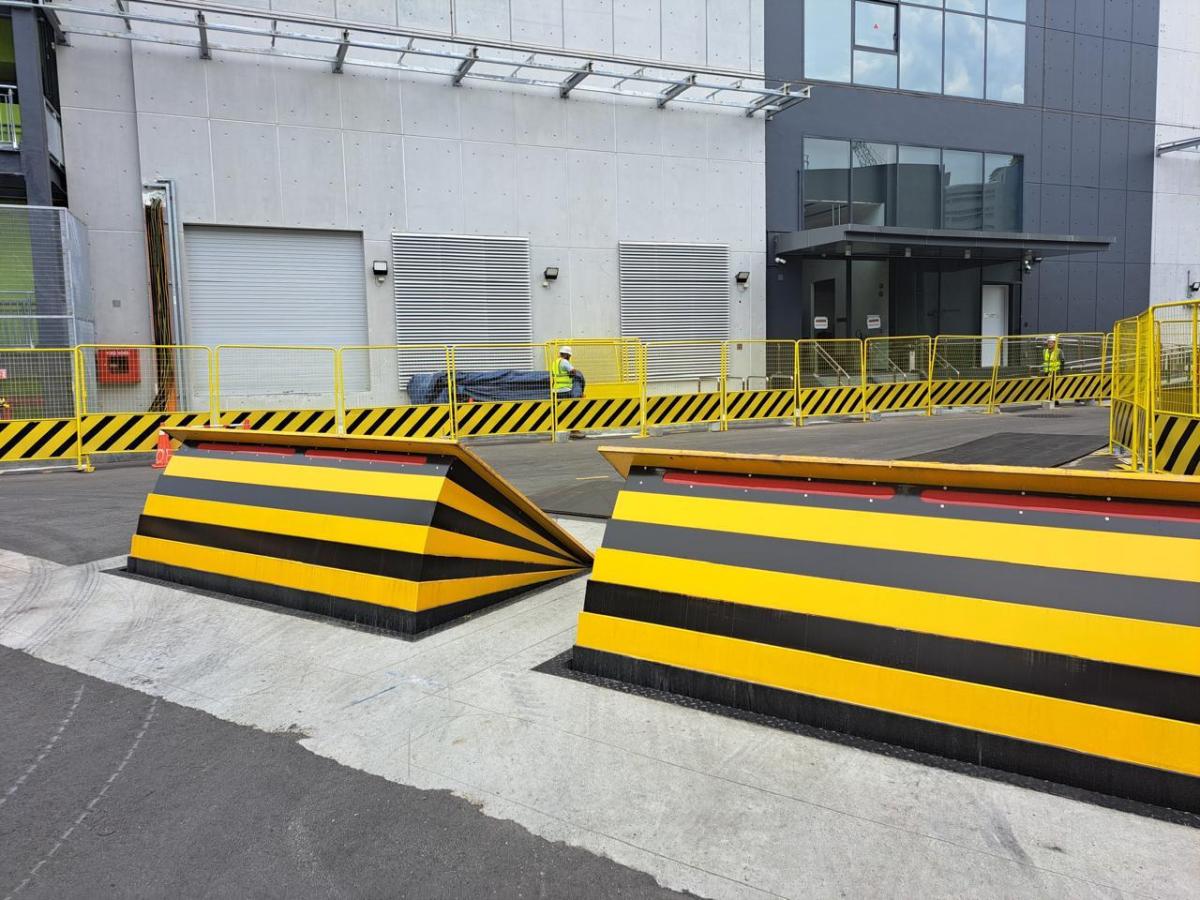
Two Vantage Security road blockers raised side by side, closing both vehicle lanes at a building entrance.
What should a road blocker specification include?
Before you sign off a road blocker specification, confirm that each item below is written into it rather than assumed.
- Crash test: The standard, test vehicle, speed, impact angle and penetration as written in the test result, for example PAS68:2013 V/7500(N3)/80/90:0.0, not just a rating name.
- Installation as tested: The foundation drawing, pit depth and reinforcement that match the crash test.
- Lane & height: The clear lane width each unit must close and the raised height of the plate.
- Ground conditions: Services under the entrance, drainage and whether a shallow mount unit is needed.
- Speed of operation: The normal rising time and the EFO time.
- Power failure: Accumulator, battery, manual pump or UPS, and which position the plate should take when power is lost.
- Safety: Inductive loops, traffic lights, warning lights and signage.
- Integration: Access control, RFID or ANPR, intercom, interlocking, fire alarm and central control.
- Finish & environment: Corrosion protection such as hot dip galvanising, the IP rating of the electrics and a working temperature range that covers Gulf summer heat.
- Duty: The expected number of cycles a day and the rated service life.
Frequently asked questions
What is a road blocker?
A road blocker is a steel barrier set into a pit across a vehicle lane. Hydraulic cylinders raise its front edge into a wedge that stops vehicles, and lower it flush with the road so authorised traffic can drive over it. Crash rated road blockers are tested to stop a truck driven at them.
What is the difference between a road blocker and a bollard?
A road blocker closes the full width of a vehicle lane with one steel plate. Bollards are separate posts, fixed or retractable, set in a line with gaps that pedestrians can walk through. Road blockers usually suit single vehicle lanes, while bollards suit wider entrances and pedestrian routes.
What does K12 mean on a road blocker?
K12 is a US Department of State crash rating for a 6,800 kg truck at 50 mph, which is 80 km/h. K4 and K8 are the same truck at 30 mph (48 km/h) and 40 mph (64 km/h). The ASTM F2656 equivalent of K12 is M50.
What is the difference between K12 and M50?
Both describe a 6,800 kg truck at 80 km/h. K12 is the older US Department of State rating. M50 is the ASTM F2656 rating that replaced it, and it adds a penetration rating from P1, 1 metre or less, to P4, more than 30 metres.
What does PAS 68 V/7500(N3)/80/90:0.0 mean?
It describes a vehicle security barrier tested with a 7,500 kg truck in vehicle class N3 at 80 km/h, hitting head-on at 90 degrees, with 0.0 metres of penetration. The Vantage Security VV-VM7501-RBZ4 road blocker carries this PAS 68 rating.
How deep does a road blocker need to be installed?
It depends on the type. Shallow mount road blockers need a pit only a few hundred millimetres deep, while deep mount road blockers need a pit of around a metre or more. The foundation must match the one used in the crash test for the rating to hold. The Vantage Security VV-VM7501-RBZ4 needs 300 mm and the VV-VM7000-RBZ4 880 mm.
Can a road blocker work during a power cut?
Yes, if it is specified to. A hydraulic accumulator, a battery or UPS, or a manual hand pump lets the plate be raised or lowered when the mains supply fails. Vantage Security road blockers offer one or more of these backups.
How fast does a road blocker rise?
Most road blockers rise in 3 to 5 seconds in normal use. With emergency fast operation (EFO), the plate rises in about 1.5 to 2 seconds. Vantage Security road blockers rise in 3 to 5 seconds, or 2 seconds or less with EFO.
Choosing the right road blocker
Work from the approach, not the catalogue. Measure how fast a vehicle could be travelling when it reaches the lane, decide how far past the barrier is acceptable, and check what lies under the road before you pick a pit depth. Then specify the crash test in full, the power failure behaviour, the safety loops and the integration with access control. If you would like help matching a road blocker to your site, talk to the Vantage Security team.