EAS Security Gates and Retail Anti-Theft Systems: Complete Buyer Guide for MEA and GCC
July 9, 2026
Retail theft is one of the largest hidden costs in any shop. Across the GCC and the wider MEA region, supermarkets, fashion outlets, pharmacies and electronics stores all face the same problem: stock that walks out of the door. Electronic Article Surveillance (EAS) is the proven answer. Industry studies suggest a well-configured EAS system can cut external shrinkage by 50 to 90 percent, and the antenna gates at the exit are a visible deterrent in their own right. As organised retail crime grows and modern mall and supermarket formats expand across the region, more operators are treating EAS as standard fit-out rather than an afterthought.
This buyer guide explains what an EAS security gate is, how AM and RF systems differ, the types of gates and accessories Vantage Security supplies, and how to choose the right system for your store before requesting a quote.
Table of contents
- What is an EAS security gate and how it works
- AM vs RF: the core decision
- Types of EAS systems in the Vantage range
- Vantage EAS antenna gates compared
- Tags, labels and deactivators
- How to choose the right EAS system
- Getting the best detection and fewer false alarms
- Installation and support across the GCC and MEA
- Why source your EAS system from Vantage Security
- Frequently asked questions
- Get a quote for your retail EAS system
What is an EAS security gate and how it works
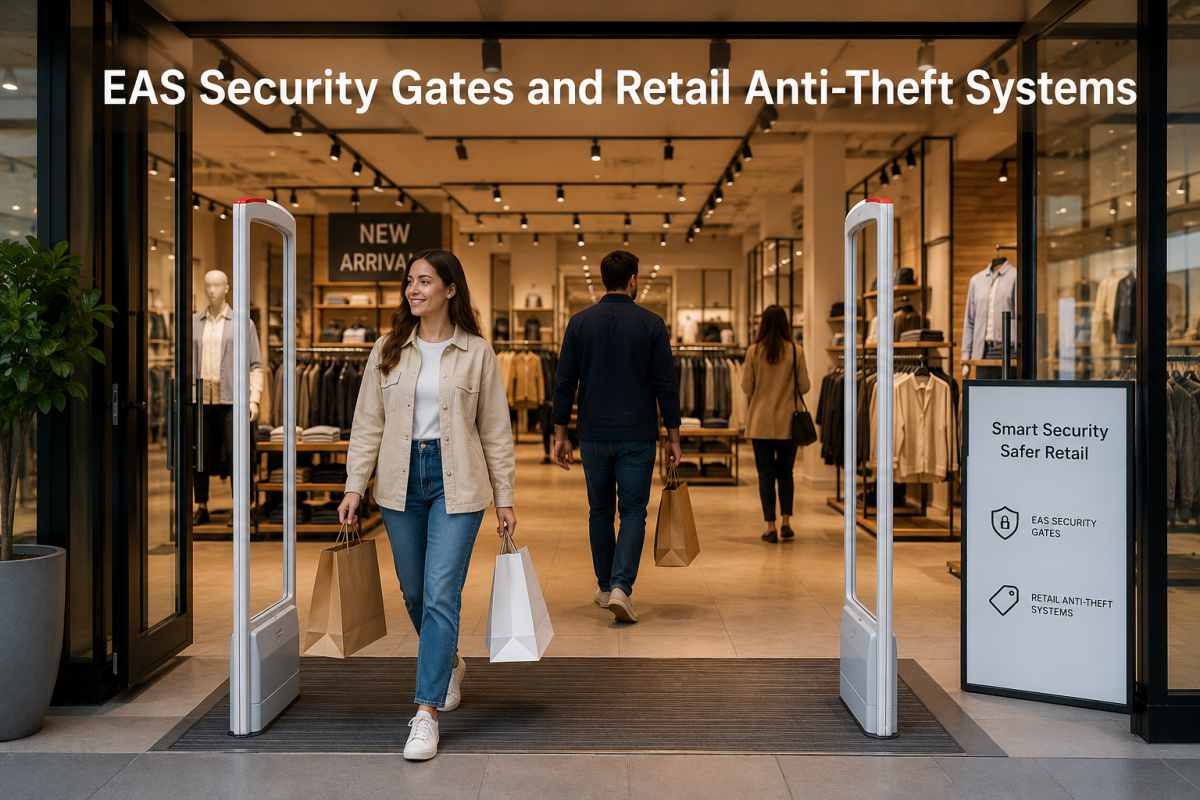
An EAS security gate is an electronic anti-theft barrier installed at a store exit. A complete system has three parts that work together. First, antenna gates, a transmitter and receiver pair that create a detection field across the doorway. Second, tags and labels attached to merchandise: reusable hard tags for garments and electronics, or disposable soft labels for packaged goods. Third, a deactivator or detacher at the checkout that switches off a label or removes a hard tag once an item is paid for.
The logic is simple. When a paid item passes through the gates, its tag has already been deactivated or removed, so nothing happens. If an active tag passes through, the gates detect it and raise an audible and visual alarm. The result is a strong deterrent at the point where theft actually happens, the exit.
AM vs RF: the core decision
Almost every EAS buying decision comes down to one question: acousto-magnetic (AM) or radio frequency (RF). The two technologies use different frequencies and suit different stores.
AM systems run at 58 KHz. They offer higher detection accuracy, fewer false alarms, and cope better near metal shelving and foil packaging, which is why they are the usual choice for supermarkets, pharmacies and cosmetics. AM also supports wider aisles, up to around 2.4 metres per pair. RF systems run at 8.2 MHz. They are lower cost, both for the gates and the labels, and work well for fashion, apparel and general retail, with aisle coverage up to around 1.8 metres per pair. RF can be more sensitive to interference near large metal fixtures or dense electronics.
| Factor | AM (58 KHz) | RF (8.2 MHz) |
|---|---|---|
| Aisle width per pair | Up to ~2.4 m | Up to ~1.8 m |
| Detection accuracy | Higher, fewer false alarms | Good, can be affected by metal |
| Best for | Supermarkets, pharmacy, cosmetics, metal-rich stock | Fashion, apparel, general retail |
| Tag and label suitability | Hard tags and AM labels | Hard tags and adhesive RF labels |
A third option is emerging. RFID-based loss prevention adds item-level stock tracking on top of anti-theft, so security and inventory visibility run on the same tags. It suits larger or fashion-forward retailers, and it is worth asking about if inventory accuracy matters to you as much as shrinkage.
Types of EAS systems in the Vantage range
Vantage supplies a full retail anti-theft range across both technologies, plus concealed systems and the deactivators that complete a deployment.
1. AM antenna gates (58 KHz)
Floor-standing antenna pedestals for supermarkets and large stores. The V-EA3000-AMJ3 is a value PVC unit, the V-EA3200-AMJ3 steps up to a premium acrylic finish, and the V-EA5000-AMD7 is a slim ABS gate with a built-in digital alarm counter and the widest detection in the range, up to 2.6 metres for hard tags.
2. RF antenna gates (8.2 MHz)
Cost-effective gates for fashion and general retail. The acrylic V-EA4000-RFJ3 and V-EA4400-RFJ3, and the aluminium-alloy V-EA4200-RFJ3 and V-EA4600-RFJ3, all give a 0.9 to 1.8 metre detection aisle with low false-alarm rates and simple installation.
3. Concealed floor and ceiling systems
Where a clean, uncluttered entrance matters, the V-EA5000-AMJ3 hides the antennas under the floor or above the ceiling. It uses advance DSP technology to cover a rectangular zone of around 4 square metres up to 1.6 metres in height, with remote control to fine-tune the settings. There is no visible gate at all.
4. Deactivators and detachers
To complete a system you need a way to clear tags at the checkout. The V-EA3110DT-AMJ3 deactivates AM (58 KHz) labels and the V-EA4110DT-RFJ3 deactivates RF (8.2 MHz) labels, both as a compact counter pad. Reusable hard tags are removed with a magnetic detacher instead.
Vantage EAS antenna gates compared
The table below summarises the seven antenna gates so you can match a system to your store. Frequency, detection aisle and material are the specifications that most often decide the choice.
| Model | Type / frequency | Detection range (aisle) | Material | Weight (per pair) | Best suited for |
|---|---|---|---|---|---|
| V-EA3000-AMJ3 | AM, 58 KHz | 1.2 to 2.4 m | PVC | 28 kg | Supermarkets, value option |
| V-EA3200-AMJ3 | AM, 58 KHz | 1.2 to 2.4 m | Acrylic | 42 kg | Supermarkets, premium finish |
| V-EA5000-AMD7 | AM, 58 KHz | 1.8 to 2.6 m (hard tag) | ABS | 14 kg | Wide aisles, alarm counter |
| V-EA4000-RFJ3 | RF, 8.2 MHz | 0.9 to 1.8 m | Acrylic | 32 kg | Fashion, general retail |
| V-EA4200-RFJ3 | RF, 8.2 MHz | 0.9 to 1.8 m | Aluminium alloy | 18 kg | Fashion, durable frame |
| V-EA4400-RFJ3 | RF, 8.2 MHz | 0.9 to 1.8 m | Acrylic | 28 kg | Fashion, general retail |
| V-EA4600-RFJ3 | RF, 8.2 MHz | 0.9 to 1.8 m | Aluminium alloy | 21.5 kg | Fashion, wide aisles |
Specifications are indicative and subject to change. Request the latest datasheet for full details.
Tags, labels and deactivators
The gates are only half of a system. The tags and labels you choose, and the way staff clear them at the till, decide how smoothly the store runs.
- Soft labels: thin, disposable adhesive labels for packaged goods. Cheap enough to leave on the product, they are switched off by swiping over a deactivator pad at the checkout.
- Hard tags: reusable plastic tags pinned to garments, shoes and electronics. They are removed with a magnetic detacher at the till and reused, which lowers running cost for fashion retailers.
- Deactivators and detachers: the AM and RF deactivator pads switch off labels, while a detacher removes hard tags. Match the deactivator frequency to your gates, AM with AM, RF with RF.
One rule governs the whole system: tags, labels, gates and deactivators must share the same frequency. An RF label will not trigger an AM gate, and the reverse is also true, so the technology choice flows through every consumable you buy.
How to choose the right EAS system for your store
Start with the store, not the brochure. Three factors decide most deployments.
By store type
- Supermarkets, pharmacies and cosmetics: AM gates handle metal shelving and foil packaging with fewer false alarms. The V-EA3000 or V-EA3200 are typical choices.
- Fashion, apparel and general retail: RF gates are cost-effective and pair well with hard tags and adhesive labels. The V-EA4000 to V-EA4600 range fits here.
- Electronics and high-value stock: AM is usually preferred for accuracy, with hard tags on the items themselves.
- Premium storefronts and malls: the concealed V-EA5000-AMJ3 keeps the entrance clean with no visible gate, while the V-EA5000-AMD7 adds an alarm counter for loss-prevention reporting.
By aisle width
Measure the clear opening at the exit. A single pair of RF antennas covers up to about 1.8 metres, and a single pair of AM antennas up to about 2.4 metres. Wider entrances need additional antenna panels in line to keep full detection across the opening, so a 4 metre doorway typically uses a multi-antenna run rather than one pair.
By visibility and reporting
Decide whether a visible deterrent or a clean look matters more. Visible gates discourage theft on sight; concealed floor or ceiling systems protect the aesthetic of a flagship store. If you want shrinkage data, choose a gate with an alarm counter.
Getting the best detection and fewer false alarms
Two things separate a system that works from one that frustrates staff and shoppers: correct installation and a tidy tagging routine. Keep antenna pairs at the rated spacing and properly aligned, and site them away from large metal fixtures, motors and electronic displays that can interfere with the detection field. Make sure every label is deactivated and every hard tag removed at the till, because a single missed tag is the most common cause of a so-called false alarm. For metal-rich or foil-packed stock, AM at 58 KHz holds up better than RF. Finally, calibrate the system on site after installation and re-check it whenever the store layout changes, since new shelving or signage near the exit can shift performance.
Installation and support across the GCC and MEA
An EAS system needs correct siting and calibration to perform: antenna spacing, alignment and tuning all affect detection and false-alarm rates. Vantage supplies, installs and calibrates retail anti-theft systems across the GCC, including the UAE, Saudi Arabia, Qatar, Oman, Kuwait and Bahrain, and supports projects across the wider MEA region, including Africa. Local stock, installation and after-sales service keep stores protected and downtime low.
Why source your EAS system from Vantage Security
Vantage Security is a UK-engineered, ISO 9001 and ISO 14001 certified supplier of retail security and loss-prevention systems. We offer the full EAS range, AM and RF antenna gates, concealed floor and ceiling systems, deactivators, hard tags and soft labels, backed by a regional team that handles store surveys, installation, calibration and support across the GCC and MEA. One supplier covers the gates, the consumables and the service.
Frequently asked questions
What is an EAS security gate?
An EAS (Electronic Article Surveillance) security gate is an anti-theft barrier at a store exit. Transmitter and receiver antennas create a detection field. If an item with an active tag or label passes through without being deactivated or detached at the till, the gate raises an alarm.
What is the difference between AM and RF EAS systems?
AM (acousto-magnetic, 58 KHz) systems offer higher detection accuracy, cope better with metal and foil, and support wider aisles, which suits supermarkets and pharmacies. RF (radio frequency, 8.2 MHz) systems are lower cost for both gates and labels and suit fashion and general retail. The technology must match across gates, tags and deactivators.
Can EAS gates detect both hard tags and soft labels?
Yes. EAS gates detect both reusable hard tags, used on garments and electronics, and disposable soft labels, applied to packaging, as long as the tag or label is on the same frequency as the gate.
What aisle width can an EAS gate cover?
A single RF antenna pair covers up to about 1.8 metres and a single AM pair up to about 2.4 metres. Wider entrances use additional antenna panels in line to maintain full coverage across the opening.
Get a quote for your retail EAS system
Tell us your store type, the width of your exits, and whether you prefer visible or concealed gates, and the Vantage team will recommend the right AM or RF system and provide a tailored quote or a store survey across the GCC and MEA.